Blackjack side bets pay big but cost roughly 7 to 18 times as much as the main game. Here is the exact price of 21+3, Perfect Pairs and the rest, by deck count, and what they do to a casino bonus.


As seen on...

Blackjack side bets pay big but cost roughly 7 to 18 times as much as the main game. Here is the exact price of 21+3, Perfect Pairs and the rest, by deck count, and what they do to a casino bonus.

Blackjack side bets cost you far more than the blackjack itself. At eight decks, the common 21+3 gives the casino 3.70% of every kr you stake on it, while Danske Spil’s main game costs about 0.51%. So why do they sit right next to your betting circle?
Here’s the price of every side bet we could verify, from 21+3 to Perfect Pairs. You’ll also see how deck count changes the cost, and what these bets do to a casino bonus. For the main game, start with our blackjack rules and odds guide.
Last updated: 23 October 2026
The tiles below come from our live casino category. The tag means our review found a live casino at that site. It does not say which side bets a table offers, and the order is not a ranking.



A side bet is a second, separate bet you place before the cards are dealt. It pays on your first two cards, sometimes plus the dealer’s up card, and ignores whether you win the hand. The prizes look huge, and the price is steep.
Here is the trick. Rare hands pay big, so a win feels like an event. But the pay table is set so the casino keeps a much larger slice than it does on the main game. A side bet is the souvenir shop at the end of the ride.
Is that always bad? It isn’t a scam. The odds are public, and you can price them. But “pays 100 to 1” sounds very different once you know it happens about once in 4,091 hands. If you want to know what a percentage like this means in practice, our house edge guide explains it.
Every side bet we could verify costs several times more than the main game. The table gives the pay table, the cost as house edge at eight decks, how often it pays and the cost over 100 bets of 10 kr.
| Bet | Pay table (to 1) | House edge, 8 decks | Pays on | Cost per 100 bets of 10 kr |
|---|---|---|---|---|
| Main game (Danske Spil, 99.49%) | Blackjack pays 3 to 2 | 0.51% | not applicable | about 5 kr |
| 21+3 | 100 / 40 / 30 / 10 / 5 | 3.70% | 9.73% of hands | 37 kr |
| Perfect Pairs | 25 / 12 / 6 | 4.10% | 7.47% of hands | 41 kr |
| Hot 3 | 100 / 20 / 4 / 2 / 1 | 5.40% | 23.7% of hands | 54 kr |
| Bust It | 250 / 100 / 50 / 9 / 2 / 1 | 5.88% | 26.8% of hands | 59 kr |
| Buster Blackjack | 2000 / 800 / 250 / 50 / 18 / 4 / 2 | 6.13% | 28.2% of hands | 61 kr |
| Top 3 | 270 / 180 / 90 | 9.00% | 0.75% of hands | 90 kr |
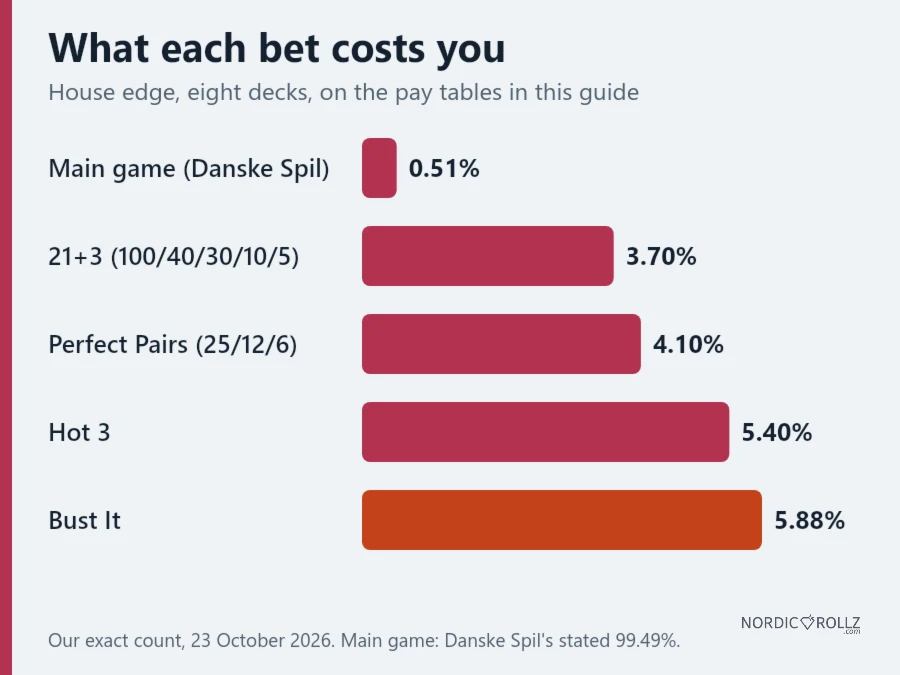
Put plainly, 100 bets of 10 kr is 1,000 kr staked. On average the main game keeps about 5 kr of that. 21+3 keeps 37 kr, and Top 3 keeps 90 kr. These are averages over a very long run, not what happens in one evening.
The prices come from our own exact count of every card combination, not from a simulation. We read the pay tables from regulators and operators, then counted each bet on its primary table. The next sections walk through the bets one by one.
21+3 turns your two cards and the dealer’s up card into a three-card poker hand. On the usual pay table it costs 3.70% at eight decks. Among the usual pay tables, that’s the cheapest we priced. The hands and prizes are these:
| Hand | Pays (to 1) | How often, 8 decks |
|---|---|---|
| Suited three of a kind | 100 | 1 in 4,091 |
| Straight flush | 40 | 1 in 485 |
| Three of a kind | 30 | 1 in 193 |
| Straight | 10 | 1 in 32 |
| Flush | 5 | 1 in 17 |
Add them up and 21+3 pays on 9.73% of hands, so on about one hand in ten. Most of those wins are a flush or a straight at 5 or 10 to 1. The 100 to 1 headline is a lottery ticket. If the poker hand names are new to you, our three card poker guide covers the rankings.
Danske Spil publishes the numbers for this one. Its Blackjack Pro help page uses 8 decks reshuffled after every round and gives the player’s theoretical return on 21+3 as 96.29%. Our exact count gives 96.296%, which rounds to 96.30. That’s close enough to confirm we’re reading the same game.
Watch for a cheaper-looking version, though. Österreichische Lotterien publishes its Infinite Blackjack terms with three of a kind at 25 to 1 instead of 30. At eight decks that table costs 6.29%, a return of 93.71%. The operator states 93.7% to 99.5% for the whole game, so that fits the low end, but the page gives no figure for this bet and no deck count. Same name, about 70% dearer.
One more detail, because it’s a neat one. 21+3 was patented. US patent 6,481,719 was granted in 2002, and Google Patents lists Galaxy Gaming as the current assignee but shows the patent as expired. A New Jersey rule proposal would also require a sign at the table with the payout odds and hand rankings if they aren’t on the layout.
Perfect Pairs pays when your first two cards form a pair, and the prize depends on how alike the cards are. At eight decks the usual 25 / 12 / 6 table costs 4.10%. It pays on 7.47% of hands. The three pair types are:
| Pair type | Example | Pays (to 1) | How often, 8 decks |
|---|---|---|---|
| Perfect pair | Same rank and suit | 25 | 1 in 59 |
| Coloured pair | Same rank, same colour, different suit | 12 | 1 in 52 |
| Mixed pair | Same rank, different colour | 6 | 1 in 26 |
Danske Spil shows 95.91% for this bet at 25 / 12 / 6, and our exact count is 95.904%, which rounds to 95.90. We are a hundredth lower. We don’t know why, and both numbers say the same thing: about 4.1% goes to the house.
Here’s where it gets interesting. Pennsylvania’s rules let the casino pick between two Perfect Pairs tables in its own rules submission: Paytable A at 25 / 12 / 6 and Paytable B at 30 / 10 / 5. Which one is better for you? It depends on the decks.
| Decks | Table A (25 / 12 / 6) | Table B (30 / 10 / 5) | Cheaper for you |
|---|---|---|---|
| 4 | 10.14% | 10.63% | A |
| 6 | 6.11% | 5.79% | B |
| 8 | 4.10% | 3.37% | B |
So B wins from six decks up, and A wins at four decks and below. A table that looks more generous at the top (30 to 1) is not always the cheaper one. Always check the full table plus the deck count, never just the headline prize.
These four are newer, and all four cost more than 21+3 or Perfect Pairs at eight decks. We priced them from published pay tables. The prices assume eight decks and a dealer who stands on soft 17. The Austrian Lotteries page gives neither, so Hot 3 and Bust It are the least certain prices here.
Top 3 is the pricey one. Of every 10 kr you put on it, about 0.90 kr disappears on average. That’s a remarkable way to buy a 270 to 1 lottery ticket.
Other names come up as well, such as Any Pair, Crazy 7, Bust Bonus and Lucky Ladies. We name them but don’t price them, because we found no verified pay table. If a table offers one of these, the same rule applies: find the pay table before you bet.
Fewer decks make 21+3 and Perfect Pairs dramatically more expensive. The pay table doesn’t change, but the chance of the winning hands does. The table shows the cost by deck count:
| Decks | 21+3 (100 / 40 / 30 / 10 / 5) | Perfect Pairs (25 / 12 / 6) |
|---|---|---|
| 1 | 18.21% | 47.06% |
| 2 | 11.17% | 22.33% |
| 4 | 6.39% | 10.14% |
| 6 | 4.62% | 6.11% |
| 8 | 3.70% | 4.10% |
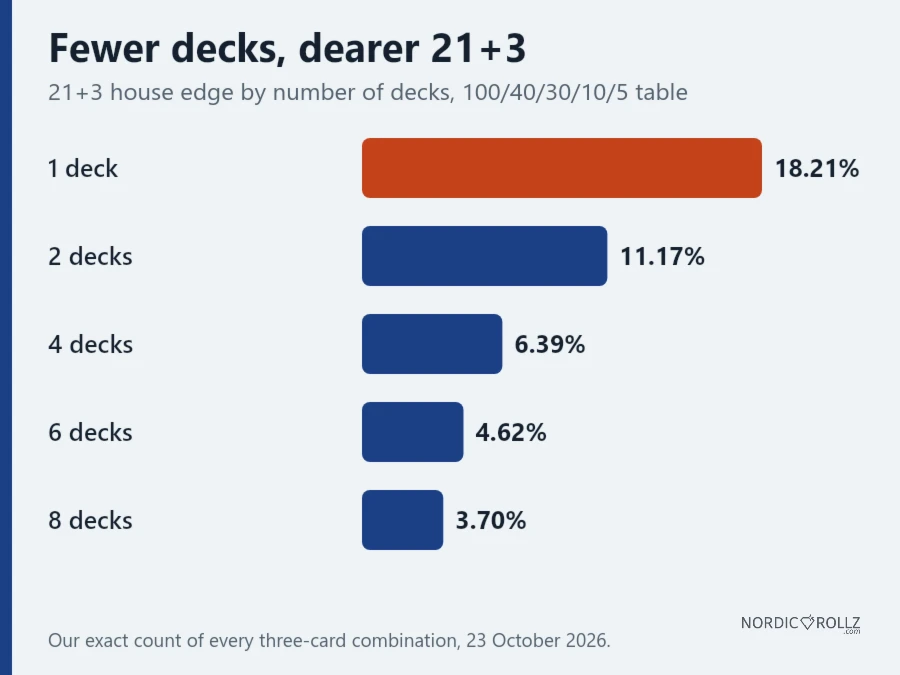
Look at the single deck row. A perfect pair can’t happen with one deck, because there is only one card of each rank and suit. Suited three of a kind needs three identical cards, so it’s impossible with one or two decks. That top prize is simply never paid there.
The lesson is simple. A side bet at eight decks is expensive. The same bet at one or two decks is far worse, even though the pay table looks identical. Before you place it, find the deck count in the game help.
They can make a bonus not worth clearing. ComeOn Sweden counts live blackjack at only a fraction toward wagering, and its terms do not say side-bet stakes are treated differently. Here is a worked example from a real set of terms.
ComeOn Sweden Ltd is licensed in Sweden (licence 25Si1515). Its welcome terms say, in Swedish: “Samtliga Live Casino-spel bidrar med 10% till bonusens omsättningskrav”. In English, all live casino games contribute 10% toward the wagering requirement.
A listed set of game shows counts at 100%, and blackjack is not among them. The terms also say RNG blackjack contributes 10%. The bonus plus deposit must be wagered 20 times, with a maximum stake of 30 kr a round.
Say you deposit 250 kr and receive a 750 kr bonus. That is 1,000 kr, so 20,000 kr of wagering. At a 10% contribution, you must stake 200,000 kr on blackjack. What does that cost on average?
| Where you stake the 200,000 kr | House edge | Average cost |
|---|---|---|
| Main game (assuming Danske Spil’s 99.49%) | 0.51% | about 1,020 kr |
| 21+3 at 8 decks | 3.70% | about 7,400 kr |
Even on the main game, the expected cost of 1,020 kr is more than the 750 kr bonus. On 21+3 it is about 7,400 kr. At the 30 kr cap, 200,000 kr is at least 6,667 rounds.
The terms don’t mention side bets separately. Read literally, every live blackjack stake counts 10%, side bets included. We haven’t checked how ComeOn’s software treats a side-bet stake, so confirm with support before you rely on it. Our ComeOn review covers the casino itself. For bonuses where wagering is not a problem, see our guide to bonuses without wagering requirements.
Spend a minute in the game help first. A side bet is only as good as its pay table, and the table is the casino’s choice. Follow these steps:
If the game help doesn’t show the pay table, we’d skip the bet. Our live dealer casino guide explains how live tables and their studios work.
If gambling stops being fun, set limits or take a break. Our responsible gambling page lists tools and where to get help.
Not by itself. Card counting is built for the main game and needs a deep shoe. We did not price counting on side bets. At Danske Spil the eight decks are reshuffled after every round, so there is no deep shoe to count. Our card counting guide shows how small that edge is on the main hand.
The same goes for strategy. A correct play per our strategy chart lowers the main game’s cost. It does nothing for a side bet, because the side bet pays on the first cards, not on your decisions.
Among the usual pay tables we priced, 21+3 at eight decks is the cheapest at 3.70%, followed by Perfect Pairs at 4.10%. Pennsylvania’s alternative Perfect Pairs table is cheaper still at eight decks, at 3.37%. “Best” is relative, because both cost many times more than the main game. Hot 3, Bust It, Buster Blackjack and Top 3 cost 5.40% or more.
Not for the odds. Every side bet we priced is much dearer than the main game at 0.51%. If you enjoy them, treat the stake as entertainment and size it accordingly.
The usual table pays 100 to 1 for suited three of a kind and 40 to 1 for a straight flush. Three of a kind pays 30 to 1, a straight 10 to 1 and a flush 5 to 1. Some tables pay only 25 to 1 for three of a kind, which raises the cost to 6.29% at eight decks.
A perfect pair pays 25 to 1, a coloured pair 12 to 1 and a mixed pair 6 to 1 on the common table. Pennsylvania also lets casinos use 30, 10 and 5 to 1. Which is cheaper depends on the deck count.
At eight decks it pays on 9.73% of hands, about one in ten. A flush comes about once in 17 hands. Suited three of a kind comes about once in 4,091.
Don’t count on it. ComeOn Sweden’s terms count live casino games at 10% toward wagering and don’t mention side bets separately. Check the terms of the bonus you’re using before you place any stake.
No. The side bet is a separate wager with its own price. The main game costs the same whether you place the side bet or not.
Sometimes. Danske Spil prints its theoretical return for 21+3 and Perfect Pairs. Many providers don’t, so use the pay table and deck count with our tables instead.
We counted every bet ourselves on 23 October 2026. The method is exact enumeration of ordered card draws from a shoe of 1, 2, 4, 6 or 8 decks, not a simulation. For 21+3, Top 3 and Hot 3 we used the player’s two cards plus the dealer’s up card. For Perfect Pairs we used the player’s two cards. For Bust It and Buster Blackjack we counted the dealer’s draw from the shoe after your two cards, with the dealer standing on soft 17.
That method ignores other players’ cards and your own hits. The Austrian Lotteries page does not state the deck count or the dealer’s rule on soft 17, so for Hot 3 and Bust It we assumed eight decks and a dealer who stands on soft 17. Our counts match two published figures: Danske Spil’s 96.29% for 21+3 and its 95.91% for Perfect Pairs (we get 95.90). The Austrian Lotteries state a game-wide range of 93.7% to 99.5%, and our 93.71% for its 21+3 table falls at the low end.
What we did not verify matters too. Evolution’s own help pages for its live games weren’t readable, so we don’t price Any Pair, Crazy 7, Bust Bonus or Lucky Ladies. We only read Danske Spil’s and ComeOn Sweden’s pages for Nordic operators, so we don’t say which other Nordic casinos offer which side bets. We found no Nordic regulator rule on side bets.
We opened no account and did no hands-on test. This page rests on the primary sources below and our own maths. How we work is in how we rate, and our casino list shows the operators we review.






New reviews, guides and bonus news by email. Unsubscribe at any time.

NordicRollz is an independent casino comparison site covering the Nordic market: Norway, Sweden, Denmark, Finland, and Iceland. Published by NordicRollz LTD, Malta, we research and rate operators on licensing, payment methods, and player protections. Our reviews are not paid placements. For full details on how we evaluate casinos, see our How We Rate methodology and our Advertiser Disclosure.
Publisher: NordicRollz LTD
Company Number: 154921
Registered Address:
Tower Business Centre,
Tower Street, BKR 4013 Swatar, Malta
You are in safe hands





New reviews, guides and bonus news by email. Unsubscribe at any time.