House Edge Explained: What Every Casino Game Costs and What the Nordic Operators Actually Publish
The house edge is the share of each bet a casino keeps on average. We price every game in our rules-and-odds series in one table, show how much it costs over a session, and check what Danske Spil, Svenska Spel, Norsk Tipping and Veikkaus publish and what the Nordic rules require.
Home > Guides > Game Rules and Odds > House Edge Explained: What Every Casino Game Costs and What the Nordic Operators Actually Publish
The house edge is the share of every bet a casino keeps on average over the long run. Take European roulette, with a 2.70% house edge: it keeps 2.70 out of every 100 you bet, on average. Not from every bet, though. You win some rounds and lose others, but over enough rounds your losses drift towards that share of your stakes. A 2.70% edge is a 97.30% return to player (RTP).
We price every game in our rules-and-odds series in one table and show what it costs in a real session. Then comes what the usual house edge pages skip. What do the Nordic operators actually publish, and what do the rules in Denmark, Sweden, Norway, Finland and Iceland require them to show you? NordicRollz, a Nordic team based in Malta, read all sources on 16 October 2026.
Last updated: 19 October 2026
Casinos with a live casino
These tiles come from our live casino category. The tag means our review found a live casino at that site. It doesn’t tell you which tables or rules the site offers, and the order isn’t a ranking.
Every casino game pays winning bets a little less than the true odds would justify. That gap is the house edge. Betting has the same gap under another name, the margin or overround, and our overround calculator measures it for any market. The rules and the pay table build it in, so it doesn’t depend on the casino’s mood, your luck or the time of day.
Start with a single number on a European roulette wheel. There are 37 pockets, so that number wins once in 37 spins on average. A fair game would pay 36 to 1. The table pays 35 to 1. So bet 1 on each of the 37 numbers and you stake 37 to get back 36. The house keeps 1 out of 37, which is 2.70%.
The same idea holds for every game, in three formulas:
House edge = average loss divided by the amount bet, shown as a percentage.
Return to player (RTP) = 100% minus the house edge, when both are measured against the same amount.
Expected loss = amount bet × number of rounds × house edge.
House edge and RTP: the same number seen from two sides
Slot providers and live studios usually quote the RTP. Table game guides usually quote the house edge. Same number, different side. A slot with a 96% RTP has a 4% house edge. A blackjack table that returns 99.28% has a 0.72% edge. Who sets a slot’s RTP, and who checks it? Our RTP slots guide covers that. This page covers the table games and the figures operators publish.
Is the house edge the same as the casino’s profit?
No. The house edge belongs to the game. The casino’s profit from a table also depends on how often players rebet their winnings, how long they play and how much they bring. Casinos call the money they keep, compared with the money players exchanged for chips, the “hold”. It can be much higher than the house edge, because players bet the same money again and again until it’s gone or they stop.
How is the house edge calculated?
For a bet with fixed payouts, list every possible outcome, its probability and what it pays. Then work out the average result. Three rules make it work:
Count the outcomes exactly. A roulette wheel has 37 or 38 pockets. Two dice have 36 combinations, three dice have 216. A deck of cards gives exact counts for every hand.
Use the pay table of the table you’re actually at. The same bet can cost very different amounts under two rulebooks. A two-dice combination in sic bo pays 6 to 1 in the Singapore rules (2.78% edge) and 5 to 1 at the US minimum (16.67%). Our sic bo guide shows both.
Where you make decisions, assume the best play. In blackjack, video poker and the poker-style table games, the published edge assumes you play perfectly. Play worse and you pay more.
A worked example: the banker bet in baccarat
With eight decks, the banker hand wins 45.86% of the time and the player hand wins 44.62%. The rest are ties, and a banker bet is returned on a tie. A winning banker bet pays 0.95 to 1 after the 5% commission.
So, per unit bet and using the unrounded probabilities: 0.458597 × 0.95 minus 0.446247 equals about minus 0.0106. That’s a house edge of 1.06%. The figures come from our baccarat guide, which counts every hand.
Why the same game can have two edges
Some games let you put more money on the table during the round. In Ultimate Texas Hold’em you can raise up to four times the ante. So the edge can be measured two ways:
Per ante (per initial bet): the average loss divided by the ante. This is the common way to quote these games.
Per total amount staked: the average loss divided by everything you put on the table in the round, including the raise.
Take Ultimate Texas Hold’em: perfect play costs 2.19% of the ante. That is about half a percent of all the money you bet. For Three Card Poker the figures are 3.37% of the ante and 2.01% of the total staked. For Casino Hold’em they are 2.16% of the ante and 0.82% of the total. For Let It Ride they are 3.51% of one bet and 2.86% of the money staked.
Neither way is wrong. Two figures are only comparable if they use the same denominator, the amount the loss is divided by. As the Danish section below shows, published tables do not always tell you which one they use.
What does each casino game cost?
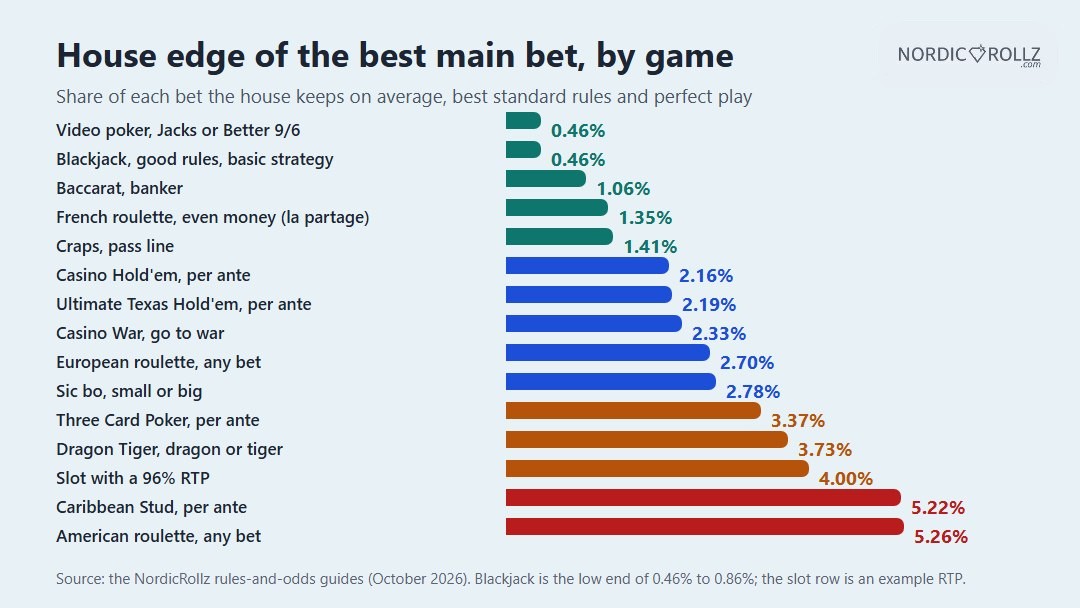
This table lists the main bet of every game in our rules-and-odds series. Each figure comes from the guide linked in the first column, where you’ll find the rulebook it is priced from and the conditions behind it. Figures for the poker-style games are per ante.
What are the casino games with the lowest house edge?
The cheapest bets in our series, on standard rules and perfect play, are full-pay Jacks or Better video poker (0.46%) and blackjack at a good six-deck table (from about 0.46%). Next comes the banker bet in baccarat (1.06%), then the player and banker bets in Bac Bo (1.13%). Even-money bets on French roulette with la partage cost 1.35%. And the pass and don’t pass lines in craps cost 1.41% and 1.36%.
Craps also has the free odds bet, which carries no house edge at all. The catch: you can only place it behind a pass or come bet.
The most expensive bets sit inside cheap games. A baccarat table with a 1.06% banker bet also offers a Perfect Pair side bet at 25 to 1 that keeps 56.14%. Yes, you read that right. A craps table with a 1.41% pass line also takes bets on any seven at 16.67%. A game’s headline edge tells you very little about the side bets next to it.
Why the rules at your table matter more than the game’s name
Blackjack is the clearest case. Our blackjack guide shows that paying a natural at 6 to 5 instead of 3 to 2 adds about 1.35 percentage points. That turns a table near half a percent into one near 1.85%.
Video poker shows it too. The same Jacks or Better game returns anything from 99.54% on the 9/6 pay table to 95.00% on 6/5. That is a house edge roughly eleven times higher for a game that looks identical on screen.
So does Dragon Tiger. Where a tie loses half of a dragon or tiger bet, as other guides describe the online game, the edge is 3.73%. Under the Singapore rulebook it is 2.19%.
What does the house edge cost you over a session?
Multiply three numbers: the stake per round, the number of rounds and the house edge. The result is your expected loss: the average over a very large number of sessions like yours. No stake rule changes that sign. Even the Kelly criterion returns zero when the edge is against you, as our Kelly criterion calculator shows.
Game and bet
100 rounds at 10
1,000 rounds at 10
Blackjack, good table (0.46%)
4.60
46
Baccarat, banker (1.06%)
10.60
106
Craps, pass line (1.41%)
14.10
141
European roulette (2.70%)
27
270
Three Card Poker, per ante (3.37%)
33.70
337
Slot with a 96% RTP (4%)
40
400
American roulette (5.26%)
52.60
526
Two things follow. First, a faster game costs more per hour at the same edge, because you pay per round. An online slot can play several hundred rounds in the time a live roulette table spins far fewer times.
Second, the cost grows with every bet you make, including bets you place with winnings. So the 10 on every round is the stake, not the money you brought.
How likely are you to be ahead after a session?
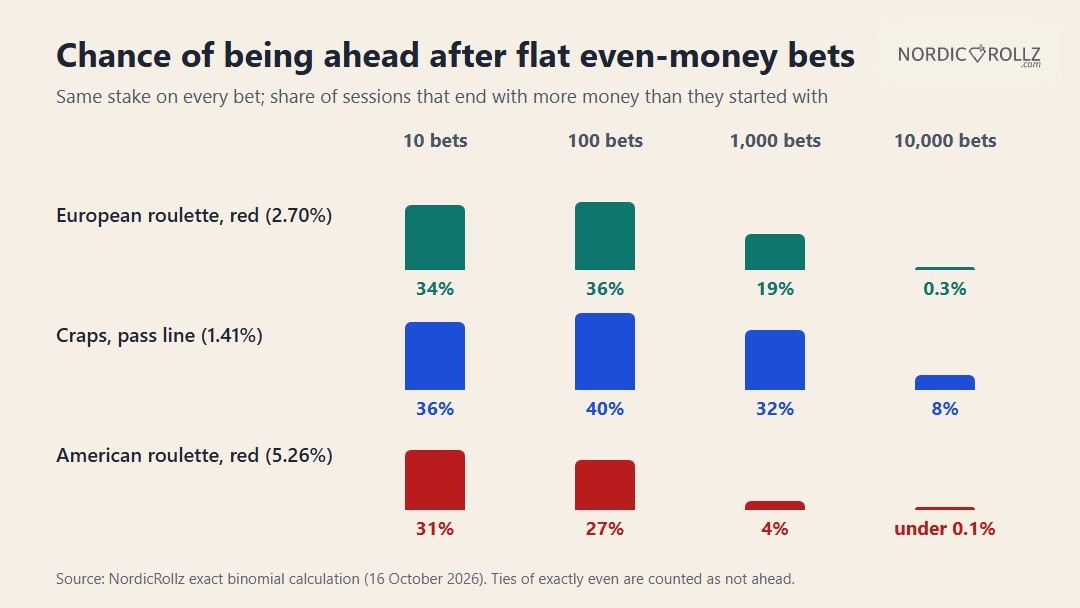
The house edge doesn’t mean you lose every session. It means your chance of being ahead shrinks the longer you play. We calculated the exact chance of finishing ahead after a run of flat even-money bets, the same stake every time. For the win-or-lose bets we used a binomial calculation. For the baccarat banker bet (ties push) and for la partage (half back on zero), we used an exact three-outcome calculation.
Bet (house edge)
After 10 bets
After 100
After 1,000
After 10,000
Baccarat, banker (1.06%)
44.5%
44.7%
35.8%
not calculated
French roulette, red with la partage (1.35%)
40.2%
43.7%
33.0%
not calculated
Craps, pass line (1.41%)
36.0%
40.5%
31.6%
7.7%
European roulette, red (2.70%)
34.4%
35.5%
18.8%
0.3%
American roulette, red (5.26%)
31.4%
26.5%
4.5%
effectively zero
Over 10 bets on European red, about a quarter of sessions end exactly even. That is why “ahead” starts so low. After 100 spins about a third of players are still ahead. After 1,000 spins fewer than one in five are. After 10,000 spins, at a 2.70% edge, it is 3 in 1,000.
A lower edge stretches that curve out but never flattens it. Even at 1.41% on the pass line, only 7.7% of players are ahead after 10,000 bets.
No betting system changes this, as our Martingale guide shows. Changing the size of your bets changes the shape of your results, not the average cost.
What do the Nordic operators actually publish?
This is the part most house edge pages leave out. The English-language house edge pages we read gave no source for their figures, and none covered the Nordic operators. The Nordic state-owned operators do publish their own figures, and they don’t all do it the same way.
Denmark: Danske Spil prints a return for the live tables it lists
Danske Spil’s winning chances page lists a return percentage for eleven bets at its live casino tables (Danske Spil: winning chances). It marks the figure “TBT %” for “Tilbagebetalingsprocent” (return percentage). Set against the figures in our own guides, they line up well:
Danske Spil live table
Published return
House edge implied
Our figure
Live Blackjack
99.28%
0.72%
About 0.46% to 0.86%
Live Baccarat
98.94%
1.06%
Banker 1.06%
Live French Roulette
98.65%
1.35%
Even money with la partage 1.35%
Live Roulette
97.3%
2.7%
2.70%
Live Casino Holdem, ante
97.84%
2.16%
2.16% per ante
Live Casino Holdem, bonus
93.74%
6.26%
6.26%
Live 3 Card Poker, ante
96.63%
3.37%
3.37% per ante
Live 3 Card Poker, Pair Plus
95.51%
4.49%
Matches one of the pay tables in our guide
Live 3 Card Poker, 6 Card Bonus
91.44%
8.56%
Matches one of the pay tables in our guide
Ultimate Texas Holdem, main bet
99.47%
0.53%
2.19% per ante, about 0.5% of all money staked
Ultimate Texas Holdem, Trips
96.50%
3.50%
Matches one of the pay tables in our guide
Read the last rows carefully. The Casino Holdem and 3 Card Poker figures are per ante: the 97.84% and 96.63% match our per-ante edges of 2.16% and 3.37% exactly.
The Ultimate Texas Holdem figure of 99.47% can’t be per ante, because that would be a 0.53% edge against the 2.19% that perfect play costs per ante. It matches the edge measured against all the money staked, about half a percent.
Read side by side, the table makes Ultimate Texas Hold’em look about a quarter of the price of Casino Hold’em. Per ante, the two cost almost the same: 2.19% against 2.16%. Measured on the same total-staked base, the gap is far smaller, about 0.53% against 0.82%.
Neither figure is wrong, but Danske Spil’s page doesn’t say that two different measures sit in the same column. If you compare games on a published RTP list, check that every figure uses the same base.
For its other casino games, Danske Spil gives no figure on that page. It says the winning chances for casino games are in the guide for each individual game. It also prints 55% for Keno, 45% for Lotto and Vikinglotto and 50% for Eurojackpot. Our keno guide and lotto guide cover those games.
Sweden: Svenska Spel shows RTP on its game pages
Svenska Spel’s casino lobby shows an RTP on many game tiles. Its info page for Evolution’s Red Door Roulette states an RTP of 97.3% (Svenska Spel: Red Door Roulette). Its Casino Hold’em pages list 97.84, the same figure as Danske Spil. We could not find blackjack or baccarat info pages with an RTP figure.
Norway: Norsk Tipping gives an average for KongKasino
Norsk Tipping, the state operator, says its online casino, KongKasino, pays out “ca. 95 %” of stakes as prizes on average. It also says the exact payout share is shown inside each game (Norsk Tipping: payout share in KongKasino). That is an average for KongKasino as a whole. It says nothing about the house edge of any one table. We did not collect the per-game figures, which are only visible inside the games.
Finland: a legal range, not a figure per game
Veikkaus’s game rules, adopted in 2025, state a return range for eBingo (55 to 80% of turnover) and a 50% prize pool for Eurojackpot. They give no return figure for its roulette, blackjack or slots (Veikkaus game rules, VN/7836/2025).
What Finnish law sets is a yearly average. The Ministry of the Interior’s draft decree of June 2026 would require slot machines and casino games to pay players 70 to 99.9% of their stakes over a calendar year. It says that range matches the decree in force today.
The same memo makes a point worth repeating. The return percentage describes the long-run share paid back over a year. It doesn’t express the result of a single round, the probability of winning or the size of a win (Ministry of the Interior: draft decree, consultation memo).
Iceland
We found no published return figure from the Icelandic operators.
What do the rules require casinos to show you?
A common claim is that online casinos “must” display the RTP of every game. In the Nordic countries we checked, that’s not what the rules say.
Denmark
A return percentage is not on the list of information licensed operators in Denmark must give players. The Danish executive order on online casinos (BEK nr. 682 of 11 June 2025) sets that list out in its chapter 5. It covers the age limit, responsible gambling information, a self-test, treatment options, the helpline, the ROFUS self-exclusion register and a statement on licence and supervision.
Instead, game suppliers must report the return percentage to Spillemyndigheden in a mandatory field with each game certificate. So the regulator knows it even when the player is not told. The same order caps the return of online bingo offered via TV at 45% (Retsinformation: BEK nr. 682 of 2025). See our Denmark licence page for how the licence system works.
Sweden
The Swedish Gambling Act says a licence holder must keep all relevant information about the game easily accessible to players and authorities, in Swedish. In the Act’s words, that includes “inklusive spelets vinstmöjligheter och regler” (including the game’s chances of winning and its rules) (Spellagen 2018:1138, chapter 14, section 4; Riksdagen: Spellag 2018:1138).
Spelinspektionen’s technical regulations go further in one case only. Chapter 10 of SIFS 2022:3 is titled “Återbetalningsprocent” (return percentage). Its first section says that for games with a progressive prize, the minimum level of the return percentage must be shown to the player. Chapter 11 requires game rules to be available without placing a stake (SIFS 2022:3).
So a Swedish player is entitled to the rules and the chances of winning, and to the minimum RTP of a progressive jackpot game. In the texts we read we found no general duty to print an RTP for every table. See our Sweden licence page.
Norway and Finland
Both countries run their casino games through a state operator: Norsk Tipping in Norway and Veikkaus in Finland. Norsk Tipping publishes its 95% average. We found no Norwegian rule requiring a payout percentage to be shown, but we did not read every regulation in full. Finland regulates the yearly average range, as described above. See our pages on Norway and Finland.
For comparison: Great Britain and Malta
The UK Gambling Commission is stricter. Its technical standard RTS 3C requires information that lets customers judge their chances of winning to be easily available before they gamble. The required list names a description of how the game works, the “house edge (or margin)”, and “the return to player (RTP) percentage or” the probability of winning events.
The Commission’s guidance calls these acceptable types of information about the likelihood of winning. For games with an element of skill, the guidance says operators should calculate the RTP using the auto-play strategy or a standard or published strategy (Gambling Commission: RTS 3).
That is why the help panel at a British-licensed site usually shows an RTP, a house edge or the probabilities of winning events.
Malta’s Player Protection Directive sets a floor rather than a display duty. Online games based on random number generation must pay out on average 85% or more of the money wagered, normally measured over a calendar year. The game rules must be no more than one click away from the game (MGA: Directive 2 of 2018).
An 85% floor allows a house edge of up to 15% on average. Many Nordic players use Malta-licensed sites, and our Malta licence page explains what that licence covers.
How to check the house edge before you play
Open the game’s help or info panel before you stake anything. Swedish rules require the game rules to be available without a stake. Many games show the RTP in the same panel, but not all do. Several live studios publish no RTP for their poker-style tables.
Find the RTP and subtract it from 100. That’s the house edge, if the figure is for the bet you plan to make.
Check what the figure is measured against. In games with a raise or a call, ask whether it’s per ante or per total amount staked. Our guides state both where they differ.
Read the pay table and compare it with the rulebook in our guide. A 6 to 5 blackjack payout, a 6/5 video poker table or a sic bo combination at 5 to 1 changes the price far more than the game’s name suggests.
Price the side bets separately. They usually cost several times the main bet.
Work out the session cost with stake × rounds × edge, and decide in advance how much you’re prepared to spend. Our responsible gambling page lists the limit tools and helplines in each Nordic country.
Check who licenses the site. The rules on what you must be shown depend on the licence, not on where you live. Start with our Casino Licences hub, and use our casino list and how we rate casinos to compare operators.
Advantages and limitations
What the house edge is good for:
Comparing the long-run price of two bets on a like-for-like basis.
Spotting the expensive side bets in an otherwise cheap game.
Estimating what a session is likely to cost, before you play.
What it does not tell you:
What will happen in your next session. Short runs swing far more than the edge.
How volatile a game is. Two slots with the same RTP can behave very differently; see our slot volatility guide.
How much a bonus changes the picture. Wagering requirements multiply the number of rounds you play, and so the cost; see our wagering requirements guide.
Anything about a jackpot’s current size. On a progressive game, the return depends on the meter; see our progressive jackpots guide.
Frequently asked questions
What is the house edge in simple terms?
It’s the share of each bet a casino keeps on average over a long run of rounds. A 2.70% house edge means you lose 2.70 per 100 bet on average, not in every round.
What is the difference between house edge and RTP?
They’re the same number from two sides. RTP is the share paid back to players. The house edge is the share the casino keeps. A 97.3% RTP is a 2.7% house edge, provided both are measured against the same stake.
Which casino game has the lowest house edge?
Among the games we’ve priced, the cheapest are full-pay Jacks or Better video poker (0.46% with perfect play) and blackjack at a good six-deck table (from about 0.46% with basic strategy). The banker bet in baccarat (1.06%) and the pass and don’t pass lines in craps follow.
What is the house edge in blackjack?
About 0.46% to 0.86% at a six-deck table where the dealer stands on soft 17 and you play basic strategy. A 6 to 5 payout on blackjack adds about 1.35 percentage points. Danske Spil publishes a 99.28% return for its live blackjack, a 0.72% edge.
What is the house edge in roulette?
2.70% on every standard bet in European single-zero roulette, 1.35% on even-money bets where la partage or en prison applies, and 5.26% in American double-zero roulette.
Can you beat the house edge?
Not with a betting system. In games with decisions, perfect play gets you down to the published edge, and poor play pushes it up. The odds bet in craps carries no edge, but you can only place it together with a pass or come bet that does.
Do casinos have to show the RTP?
In Great Britain, information on your chances of winning, such as the house edge, the RTP or the probability of winning events, must be easily available before you play. In Sweden, the rules and chances of winning must be easily accessible, and progressive jackpot games must show their minimum RTP. In Denmark, operators report the return percentage to the regulator, but it isn’t on the online casino executive order’s list of information for players. Danske Spil and Svenska Spel publish figures anyway.
Why do two sites quote different house edges for the same game?
Usually because the pay table differs, the rules differ (number of decks, a 6 to 5 payout, how ties are settled), or one figure is per ante and the other per total amount staked. Our guides state the rules behind every figure.
Recent changes
16 October 2026: first version, with every figure taken from our rules-and-odds guides as published on that date and the Nordic operator and regulator sources read the same day.
How we verified this
We copied the house edges in the tables from our own rules-and-odds guides. Each guide prices its game from official rulebooks (regulators in Singapore, New Jersey, Pennsylvania, Massachusetts, Nevada and other jurisdictions) by exact counting or, where stated, simulation. We checked each figure against the live guide on 16 October 2026. The session costs are stake × rounds × edge. The chances of being ahead are our own exact calculation (binomial, or three-outcome where ties push or half the stake comes back). We used 18/37 for European red, 18/38 for American red, 244/495 for the pass line, and the eight-deck baccarat probabilities from our baccarat guide.
We read Danske Spil’s winning chances page, Svenska Spel’s game pages, Norsk Tipping’s KongKasino payout pages, Veikkaus’s 2025 game rules and the Finnish Ministry of the Interior’s draft decree memo. We also read the Danish executive order BEK nr. 682 of 2025, the Swedish Gambling Act and SIFS 2022:3, the UK Gambling Commission’s RTS 3 and the MGA’s Player Protection Directive. We copied the quotations from those documents.
What we could not verify
The per-game payout shares inside Norsk Tipping’s KongKasino games.
Svenska Spel’s RTP for its blackjack and baccarat tables.
The number of Finland’s decree currently in force; the 70 to 99.9% range comes from the June 2026 draft, which states that it matches the current rules.
A Norwegian legal duty to disclose payout percentages: we found none, but we did not read every regulation in full.
Any published return figure from the Icelandic operators.