Lotto Odds Explained: What Lotto, Vikinglotto and Eurojackpot Really Pay Back
Lotto odds are fixed by the size of the number field, and the price of the game is set in the operator’s rules. We read the rules of Norsk Tipping, Svenska Spel, Danske Spil and Veikkaus and counted every prize tier. The Norwegian, Swedish and Danish lotteries state a payback of 40% to 50% of stakes, the same Vikinglotto row returns 40% in Sweden and about 50% in Norway, and almost half of Eurojackpot’s prize money sits in three tiers you will almost never hit.
Lotto odds are the easy bit: they depend only on how many numbers you pick and how many are in the drum. What a lottery costs you is harder. That depends on how much ticket money the operator pays back, and where in the prize table it sits.
On 9 October 2026 we read the rules and information pages of Norsk Tipping, Svenska Spel, Danske Spil and Veikkaus for Lotto, Vikinglotto and Eurojackpot. Then we counted every prize tier ourselves.
What stood out? Norway’s, Sweden’s and Denmark’s lotteries state a payback of 40% to 50% of stakes. The same Vikinglotto row returns 40% in Sweden and about 50% in Norway. Almost half of Eurojackpot’s prize money sits in three tiers rarer than 1 in 3 million, plus 9% in a reserve. And Norway’s regulator has fined Norsk Tipping more than 70 million kroner over draws that picked the wrong winners.
Watch the video
Prefer to see it first? This NordicRollz video walks through the main points of this guide in a few minutes.
Lotto Odds Explained: How Hard Is It to Win the Jackpot? (NordicRollz video)
How are lotto odds counted?
The number field decides everything
Your lotto row is just a handful of numbers from a fixed field. In Norway you pick 7 of 34. Sweden uses 7 of 35, Denmark 7 of 36 and Finland 7 of 40. The draw then picks seven winning numbers from the same field, and no ball goes back in.
So how many rows are possible? That’s a plain count of combinations. Seven numbers from 34 can be combined in 5,379,616 ways, and one of them wins the first prize. Your chance of seven correct on one row is 1 in 5,379,616. Nothing else enters the sum.
Each extra number in the field makes your top prize much harder to reach. Going from 34 to 40 numbers more than triples the count, to 18,643,560 rows.
What does not change the odds
Norsk Tipping says it plainly on its Lotto page: neither the number of players nor the turnover affects the chance of winning. That’s true for your chance of hitting a prize tier. Your numbers win or lose on their own.
What the crowd does change is the size of the prize. All four operators run their lotteries as pools: a fixed share of stakes is split between the winners in each tier. More winners in your tier means a smaller slice each.
The numbers you pick don’t change your chance either. They can change how many people you share with, because lots of players pick birthdays and patterns. That moves the prize, never the probability.
Bonus numbers, Viking numbers and star numbers
Most lotteries add a second draw to create middle tiers. A bonus number comes from the balls left in the drum after the main draw. If you get six correct plus the bonus number, you’re paid more than for six correct alone.
Vikinglotto and Eurojackpot work differently. Their extra numbers come from a separate, smaller field: one Viking number from 5, or two star numbers from 12. You pick those too, and the first prize needs all of them. That multiplies the number of possible rows.
The four national Lotto games side by side
Norway: 7 of 34
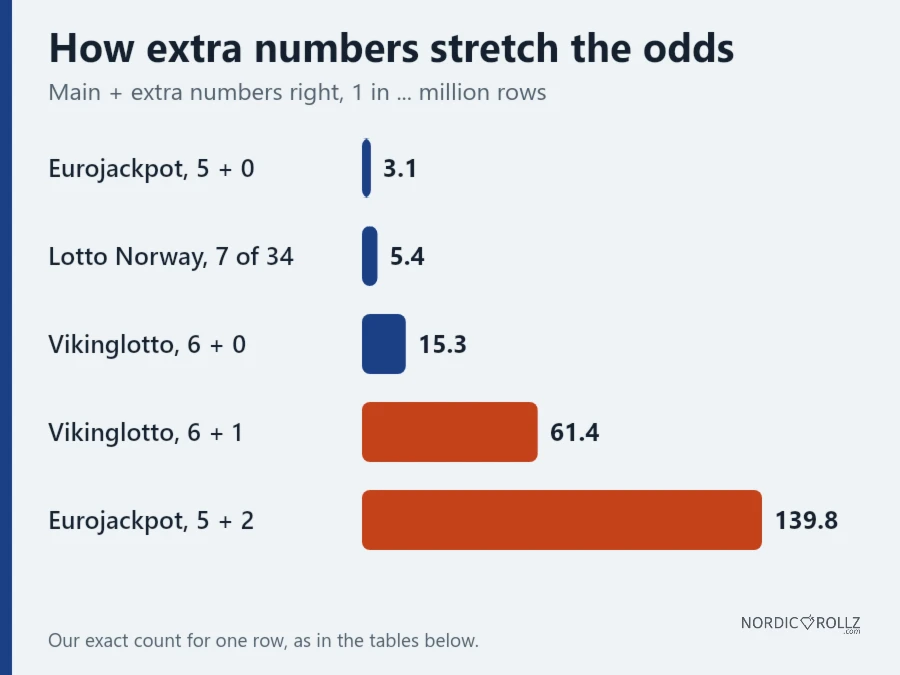
Norsk Tipping’s Lotto draws seven main numbers and one bonus number from 34. A row costs 5 kroner, and the draw is on Saturdays. Its Lotto information page puts the chance of the first prize at 1:5.4 million per row.
The same page says a player wins a prize on every fifth coupon of ten rows, on average. Our count agrees. One row in 48.9 has four or more correct, so a ten-row coupon wins something 18.7% of the time.
Sweden: 7 of 35, twice a night
Svenska Spel’s Lotto draws seven numbers and four bonus numbers from 35 balls. A row costs 4 kronor per draw. There are two draws every Wednesday and Saturday, Lotto 1 and Lotto 2, and your rows can play in both.
The rules print the chance for each of the seven prize groups, and together they add up to 1:55 per row and draw. Only Lotto 1 has a rolling jackpot. When nobody gets seven correct, the top group’s money moves on to the next Lotto 1.
Denmark: 7 of 36, drawn by a random number generator
Danske Spil’s Lotto draws seven numbers and one bonus number from 36. Here’s the detail most players miss, tucked into the game rules: the numbers are drawn "electronically via a random number generator" (our translation), approved by the Danish regulator Spillemyndigheden. The rules describe an electronic draw, while Sweden’s describe 35 balls.
Four correct pays a fixed 70 kroner. Every row you buy also joins a separate weekly draw of two prizes of 1 million kroner. On top of that come two yearly draws of 25 prizes of 1 million each, on 25 December and Easter Monday.
Finland: 7 of 40
Veikkaus’ Lotto draws seven numbers and one bonus number from 40, and a row costs 1 euro. That’s the largest field of the four, so the first prize is the hardest to hit: 1 in 18,643,560.
But Finland has a tier the others lack. Three correct plus the bonus number pays a fixed 2 euros. That’s why your chance of any prize in Finland, 1 in 49.6, sits close to Norway’s, even though the top prize is 3.5 times harder.
The exact odds per tier
The table shows our own count for one row, and it matches every figure the operators print.
Result
Norway (7/34)
Sweden (7/35)
Denmark (7/36)
Finland (7/40)
7 correct
1 in 5,379,616
1 in 6,724,520
1 in 8,347,680
1 in 18,643,560
6 + bonus
1 in 768,517
1 in 240,161
1 in 1,192,526
1 in 2,663,366
6 correct
1 in 29,558
1 in 40,027
1 in 42,590
1 in 83,230
5 correct
1 in 730
1 in 1,160 (5+1: 1 in 3,139)
1 in 979
1 in 1,681
4 correct
1 in 52.5
1 in 95 (4+1: 1 in 153)
1 in 65.3
1 in 97.6
3 + bonus
no prize
no prize
no prize
1 in 107
Any prize
1 in 48.9
1 in 54.8
1 in 61.1
1 in 49.6
Sweden draws four bonus numbers, which is why its "6 + bonus" tier is easier than the others. In Sweden the rows with a bonus number are counted apart, so "5 correct" and "4 correct" there mean without any bonus number.
How long is 1 in 5.4 million?
Say you hand in ten rows every Saturday in Norway. That’s 520 rows a year, and at that pace the first prize comes once in 10,345 years on average. Play one row in Sweden’s Lotto 1 every Wednesday and Saturday, and you wait 64,659 years.
There’s no trick hidden in those averages. Each draw is independent, so last week’s numbers say nothing about this week’s.
What do the Nordic lotteries pay back?
The printed shares
This is where the operators differ, and where the rules say more than the product pages. The table shows the share of stakes that goes to prizes, as each operator states it.
Game
Norway
Sweden
Denmark
Lotto
about 50%
46.77%
at least 45% (table: 45%)
Vikinglotto
about 50%
40%
at least 45% (table: 45%)
Eurojackpot
about 50%
50%
at least 45% (table: 50%)
Norsk Tipping uses the same sentence for all three games: prizes follow a fixed key "corresponding to about 50%" (our translation) of the stakes in each round. It adds that the share can differ a little because of rounding and, for Lotto, the money set aside for the Supertrekning.
Svenska Spel’s figures come from its game rules. Danske Spil’s rules say "at least 45%" (our translation) for each game, and its table of winning chances prints 45% for Lotto and Vikinglotto and 50% for Eurojackpot.
Why is Finland missing from the table? Veikkaus doesn’t print one figure for Lotto, and the way its first prize is set means none can be derived. We come back to that below.
Half the stake is the price
A return of 40% to 50% means the game keeps 50 to 60 kroner of every 100 staked. How does that compare? Danske Spil’s own table prints 97.3% for live roulette. Slots usually return 94% to 97%, according to our RTP guide. The same Danish table prints 55% for keno, which we cover in our keno guide. And the tickets in our scratch cards guide return 49% to 82%.
Per krone staked, the lottery is among the most expensive games on that list. People accept it because the stake is small and the draw is slow. That’s a fair reason to play. It isn’t a reason to think the odds are good.
Sweden's 46.77%, piece by piece
Svenska Spel's Lotto rules are the most detailed of the four, so they show how a prize share is built. Of every krona staked on Lotto, 46.77% is set aside for prizes:
39.76% goes to the ordinary prize plan of the draw.
3.45% goes to a fund for the Drömvinst, an extra prize for seven correct in Lotto plus two correct in the add-on game Joker.
2.77% goes to a fund for Andra Chansen, a Saturday extra draw of 1 million kronor for players who add Joker. Svenska Spel decides the number of winners.
0.79% goes to the Miljonbooster fund, which tops up the first prize so a sole winner gets at least 1 million kronor.
The plan itself splits over the seven prize groups: 20% to seven correct, then 11%, 5%, 11%, 11%, 21% and 21%. The two lowest groups, four correct with and without a bonus number, take 42% of the plan. That’s 16.7% of all stakes.
Put those shares next to the odds, and the plan implies an average prize of about 32 kronor for four correct and 51 kronor for four plus a bonus number. That’s our arithmetic on a 4-krona row. Real prizes move with the number of winners in each draw.
The rules also set a ceiling. During campaigns the plan may exceed 46.77%, but Svenska Spel must ensure that the total value of prizes over the licence period "never exceeds 50%" (our translation). In short: over the licence period, Swedish Lotto must not pay out more than half of what players stake.
Denmark: a pool for extra draws
Danske Spil’s Lotto rules split the prize money differently. First the fixed 70-kroner prizes and 1 million kroner for the weekly extra draw are taken out. Of the rest, 71% goes to seven correct, 7% to six plus the bonus number, 3% to six correct and 8% to five correct. The last 11% goes to a savings pool that pays for the draws among all rows.
So Danish Lotto is top-heavy. Of the pooled money, 71% waits for a result that turns up once in 8.3 million rows.
Finland: a first prize that turnover does not set
Veikkaus’ Lotto runs on another principle. According to the prize rules on its Lotto page, the first prize is a sum confirmed for each round, independent of the round’s turnover. Only the middle groups are shares of stakes: 3.80% for six plus the bonus number, 2.50% for six correct and 3.00% for five correct. Four correct pays a fixed 10 euros, and three plus the bonus number a fixed 2 euros.
That lets us price everything below the jackpot. One row in 97.6 has four correct, which costs the game 10.24% of stakes. One row in 107 has three plus the bonus number, another 1.86%. Add the three shares, and the groups below the first prize return 21.4% of the 1-euro stake.
The rest of the return is the jackpot. That depends on a sum Veikkaus sets, on how often it’s won and on how many rows are sold. We couldn’t read a total payback figure for Finnish Lotto, so we don’t give one.
The optional Plus bet costs 0.50 euros a row. It multiplies every prize except the first by five when the row’s own plus number, 1 of 30, is drawn. A correct plus number on a row with no other prize pays a fixed 5 euros. The multiplied prizes in one prize group are capped at 1 million euros in total.
Vikinglotto: one draw, different rules per country
Six of 48 and one Viking number
Vikinglotto is a shared Wednesday draw. Ten countries or nine? It depends who you ask. Norsk Tipping lists ten in the alliance: the five Nordic countries, the three Baltic states, Slovenia and Belgium. Svenska Spel’s guide page says nine. You pick six numbers from 48 and one Viking number from 5, which gives 61,357,560 possible rows.
Result
Chance per row
6 + Viking number
1 in 61,357,560
6 correct
1 in 15,339,390
5 correct (either way)
1 in 48,696
4 correct (either way)
1 in 950
3 correct (either way)
1 in 53.4
Any prize
1 in 50.5
Until June 2021 the Viking number came from a field of 8, which made the first prize 1 in 98 million. Norsk Tipping’s own history of the game records the change, and the Norwegian row price rose to 8 kroner at the same time.
The same euro cents from every row
The two top prizes are international. According to both the Danish and the Swedish rules, every row sold, in any country, puts 0.13 euros into the common first prize pool. Another 0.013 euros goes into the second prize pool and 0.042 euros into a reserve. That’s 0.185 euros per row in total.
The reserve guarantees a first prize pool of at least 3 million euros, and the pool is capped at 25 million euros. Everything below the two top prizes is national: each operator splits what’s left of its own prize money among its own players.
40% in Sweden, about 50% in Norway
This is where the national rules part ways. Svenska Spel’s Vikinglotto rules, last changed on 7 October 2026, state that 40% of stakes go to prizes: 4 kronor of the 10-krona row. Danske Spil’s rules say at least 45%. Norsk Tipping says about 50%, on an 8-krone row.
The number of prize groups differs too. Sweden has five: there is no extra group for five or four correct with the Viking number. Norway has six. Denmark has seven, and its lowest group pays a fixed 70 kroner for three correct.
So a Swedish and a Norwegian player in the same draw, with the same chance of the same jackpot, buy that chance at different prices. The Swedish row costs more and returns a smaller share. Take an exchange rate of 11 kronor per euro, purely as an illustration. The 0.185 euros for the international pools is then about 2.04 kronor. That’s half the Swedish prize money, with roughly 1.96 kronor left for the three national groups.
What changed on 7 October 2026
Danske Spil’s rules page carries two versions of the Vikinglotto rules: one valid until 7 October 2026 at 19:00 and one valid from that moment. We compared them, and four things changed in how the top pools behave:
The reserve pool's threshold fell from 7.5 million to 6 million euros. Money above the threshold moves to the next first prize pool.
When the first prize pool passes the 25 million euro cap, the excess now goes to the reserve. Before, it went to the second prize pool in the same draw.
An unwon second prize pool now goes to the reserve.
The separate 25 million euro cap on the second prize pool is gone from the new text. Under the old rules, a capped second prize pool sent its excess to the next first prize.
The contributions per row and the odds are unchanged. In practice, a capped jackpot no longer inflates the second prize. The Swedish rules were reissued the same day with the same mechanics, under the name Boosterfond.
Eurojackpot: where the prize money sits
Twelve tiers and a reserve
Eurojackpot is drawn in Finland every Tuesday and Friday, and Norsk Tipping counts 19 participating countries. You pick five numbers from 50 and two star numbers from 12. That gives 139,838,160 possible rows.
Svenska Spel’s rules explain the money. Half the Swedish stake, 12.50 kronor of the 25-krona row, goes to prizes. The equivalent of 1 euro per row goes into the international prize plan, which splits the prize money over twelve groups and a reserve fund. The Danish rules print the same percentages.
Result
Chance per row
Share of prize money
Average prize the plan implies
5 + 2
1 in 139,838,160
36.00%
about 50.3 million euros
5 + 1
1 in 6,991,908
8.60%
about 601,000 euros
5 + 0
1 in 3,107,515
4.85%
about 151,000 euros
4 + 2
1 in 621,503
0.80%
about 4,970 euros
4 + 1
1 in 31,075
1.00%
about 311 euros
3 + 2
1 in 14,125
1.10%
about 155 euros
4 + 0
1 in 13,811
0.80%
about 110 euros
2 + 2
1 in 985
2.55%
about 25 euros
3 + 1
1 in 706
2.85%
about 20 euros
3 + 0
1 in 314
5.40%
about 17 euros
1 + 2
1 in 188
6.75%
about 13 euros
2 + 1
1 in 49.3
20.30%
about 10 euros
Reserve fund
9.00%
The chances and shares are from the rules. The last column is our arithmetic: 1 euro of prize money per row, times the share, divided by the chance. Real prizes vary with the number of winners, and unwon pools roll over.
Almost half the money is out of reach
Add up the three top groups: 36% plus 8.6% plus 4.85% is 49.45% of the prize money. Each of those results is rarer than 1 in 3 million. The reserve fund, there to guarantee a first prize pool of at least 10 million euros, takes another 9%.
That leaves 41.55% of the prize money for the nine groups an ordinary player will ever see. Prizes are half the stake, so those groups return about 20.8% of what you pay. In everyday play, then, Eurojackpot hands back roughly a fifth of your stake. The other 29 points buy a very small chance of a very large sum.
Say you play two rows in both weekly draws. That’s 208 rows a year, and at that pace the first prize comes once in about 672,000 years. Not exactly a retirement plan.
The cap, and where the excess goes
The first prize pool never pays more than 120 million euros. Under the rules, money above the cap moves to the second group in the same draw. If that group also passes 120 million, the excess moves down to the next group that has a winner. Norsk Tipping notes that the cap was raised from 90 to 120 million euros in March 2022, when the Tuesday draw was added.
What each country does with the exchange rate
The international plan runs in euros, but three of the four Nordic operators sell in kronor or kroner. Each one handles the gap its own way.
Sweden pays out the surplus. When the exchange rate leaves part of the 12.50 kronor unused, the rules call the rest national prize money. It goes only to winners at Svenska Spel, in groups 2 to 7. It can build up when nobody in Sweden wins those groups, up to 50 million kronor for five plus one. International prizes are converted at the draw day’s rate, but never at more than 12.50 kronor per euro.
Denmark fixes the rate for small prizes. Danske Spil's rules convert prizes up to 1 million euros at 7.50 kroner per euro and larger ones at the day's rate.
Norway adds its own prizes. Every row bought from Norsk Tipping takes part in a draw of 1 million kroner each Tuesday and Friday. A Norwegian winner of five plus one gets the prize topped up from a fund. Norsk Tipping's page on the game says the fund was introduced in February 2021 as a buffer against a high euro rate.
Can you trust the draw? Norway's fines
Wrong winners for years
All the maths assumes that every row has the chance the rules promise. In Norway that assumption failed in the extra draws, and the regulator has documented it.
On 1 September 2025 Lotteritilsynet adopted a fee of 46 million kroner against Norsk Tipping. In the extra draws in Eurojackpot and the Supertrekning in Lotto, players in syndicates and share pools had a higher chance than they should have had. Players who played alone had a lower one. According to that decision the error had been there since 2015 or 2016 and was found only in 2025.
In the warning of 29 April 2025, director Atle Hamar said there had been a wrong winner in every single draw for several years. The two games had about 108 such draws a year. The notices describe the error in the extra draws only, and say nothing about the main draws.
52 wrong millionaires and 47,000 false messages
Two more cases followed. On 19 April 2025, in the Easter Supertrekning, a technical error removed 16,698 participants from the draw, and Norsk Tipping drew 52 wrong winners of million prizes. Lotteritilsynet adopted a fee of 25 million kroner on 13 November 2025. Its notice says the regulator had considered stopping the draw and was assured it would be correct.
After the Eurojackpot draw of 27 June 2025, about 47,000 Norwegian winners were told they had won far too much, and 30,000 of them got the figure by SMS or push message. The cause, in the regulator’s words, was that a formula multiplied by a hundred instead of dividing by a hundred when converting from euro cents. The draw itself was correct.
Lotteritilsynet warned of a fee of up to 10 million kroner on 16 September 2025, and its notice of 13 November 2025 lists a fee of 10 million kroner as adopted. The same notice counts five fees in a little over a year and more than 100 million kroner in total.
In July 2025 the regulator announced a full inspection of Lotto, Eurojackpot and Vikinglotto, from the entry deadline to the payout. We haven’t found its report. Our page on Norway’s gambling regulator and licence model explains who supervises Norsk Tipping.
What this means for the odds
The odds in this guide are what the rules promise. For the extra draws, the regulator found that the stated chance wasn’t the real one for years, and nobody could have known that from the rules. For the main draws we found no finding either way.
That’s the strongest argument we know for reading a regulator’s decisions, not only an operator’s product page. It applies to casinos as much as to lotteries, and it is part of how we rate the operators on our casino list.
How to read a lottery before you play
Four checks
Find the share of stakes paid back. It’s in the game rules, not on the product page. Below 50% is normal for a lottery.
Look at where the prize money sits. A game that puts 70% of its pool on the top result pays you almost nothing most weeks.
Check which prizes are fixed. A fixed 70 kroner or 10 euros is yours whatever the crowd does, while a pooled prize shrinks when many win.
Read the date on the rules. Vikinglotto’s changed two days before we wrote this, so the version you remember may be gone.
Do systems, syndicates or "hot" numbers help?
A system bet or a syndicate buys more rows. More rows mean more chances, but at the same price per chance. The return doesn’t move: every row has the same expected value.
What about number statistics? They don’t help. The draws are independent, and a number drawn often in the past is no more likely next week. The only thing your number choice can change is how many players you split a pooled prize with.
Keep it small
All four operators set limits for their games, and the national self-exclusion registers cover them. If you’d like a break, our guide to Spelpaus, ROFUS and the other Nordic registers explains how to block yourself. A lottery is cheap per week and expensive per krone, so treat the stake as money spent.
Frequently asked questions
What are the odds of winning Lotto?
It depends on the country. Seven correct on one row is 1 in 5,379,616 in Norway, 1 in 6,724,520 in Sweden, 1 in 8,347,680 in Denmark and 1 in 18,643,560 in Finland. The chance of any prize is between 1 in 49 and 1 in 61.
What are the Eurojackpot odds?
The first prize, five numbers and two star numbers, is 1 in 139,838,160 per row. The second prize is 1 in 6,991,908. The chance of any prize is 1 in 31.8, and the most common prize, two numbers and one star number, comes on 1 row in 49.3.
What are the Vikinglotto odds?
Six numbers and the Viking number is 1 in 61,357,560 per row. Six numbers without it is 1 in 15,339,390. Three or more correct comes on 1 row in 50.5.
Which Nordic lottery has the best odds?
For the first prize, Norway's Lotto at 1 in 5.4 million. For any prize at all, Eurojackpot at 1 in 31.8, but most of those prizes are close to the price of a few rows. Measured by the share of stakes paid back, Eurojackpot and the Norwegian games are highest at about 50%, and Swedish Vikinglotto lowest at 40%.
How much of the Lotto stake is paid back?
About 50% in Norway by Norsk Tipping's own description, 46.77% in Sweden and at least 45% in Denmark. Veikkaus prints no single figure for Finnish Lotto. By our count its prize groups below the first prize return 21.4% of the stake.
Does it matter when I buy my ticket or which numbers I pick?
No. The odds are the same for every row in every draw. Popular numbers, such as birthdays, can mean more players share a pooled prize. That lowers the prize, not the chance.
Are lottery winnings taxed in the Nordic countries?
Danske Spil's rules state that players' prizes are exempt from income tax. The same rules mention a gambling duty that Danske Spil calculates and settles under Danish law. For the other countries and for winnings from foreign sites, see our guide to tax-free casino winnings in the Nordics.
Sources
Norsk Tipping, "About Lotto", "About Vikinglotto" and "About Eurojackpot": norsk-tipping.no. Read 9 October 2026.
Svenska Spel, "Game rules Lotto and Joker" (last changed 9 June 2025; a new version applies from 4 November 2026), "Game rules Vikinglotto and Joker" (last changed 7 October 2026) and "Game rules Eurojackpot" (last changed 14 January 2022), linked from the game guides: svenskaspel.se/lotto/spelguide, svenskaspel.se/eurojackpot/spelguide.
Danske Spil, game rules for Lotto (in force 29 March 2025), Eurojackpot (5 March 2024) and Vikinglotto (both versions, the new one from 7 October 2026): danskespil.dk; "Winning chances": danskespil.dk.
Veikkaus, Lotto, "Information and rules": veikkaus.fi/fi/lotto. Read 9 October 2026.
All odds, waiting times and average prizes are our own exact arithmetic on the number fields and shares in those rules. The payback percentages are the operators' own. We did not read Norsk Tipping's formal game rules, the Norwegian prize split per group, Veikkaus' pages for Vikinglotto and Eurojackpot, or the Icelandic operator's rules.