Matched betting locks in a result by backing and laying the same outcome. The profit comes from free bets, and the Nordic bonus rules shrink that supply. Here is the arithmetic.


As seen on...

Matched betting locks in a result by backing and laying the same outcome. The profit comes from free bets, and the Nordic bonus rules shrink that supply. Here is the arithmetic.

Matched betting means you back an outcome at a bookmaker and lay the same outcome at an exchange, so the result is locked and only a small cost is left. The profit comes from free bets and bonuses, not from the bets themselves. In the Nordics those offers are rare, capped or banned, and that changes the maths a lot.
This page walks through the method step by step, using our own arithmetic, and shows what each Nordic country’s rules do to it.
Last updated: 2 November 2026
Matched betting is two opposite bets on the same outcome, placed so that you win one and lose the other whatever happens. You back at a bookmaker, which means you bet the outcome will happen. Then you lay the same outcome at a betting exchange, which means you bet it won’t, and you take the other side of someone else’s bet. Betfair is one example of an exchange.
Because one of the two bets always wins, the result is locked. On its own that locks in a small loss, because the exchange charges commission and the prices rarely match exactly. The method only makes money when a bookmaker hands you a free bet or a bonus, because then you risk money that isn’t yours.
Everything below is detail: how big the loss is, how much of a free bet you keep, and how far the Nordic rules let you go. Our arbitrage betting guide covers a related method that needs no bonus, and it doesn’t cover this one.
Matched betting depends on a steady stream of free bets, and the Nordic rules cut that stream. In the UK, where most guides come from, bookmakers hand out sign-up offers and reload offers freely. The Nordic countries each limit that in a different way.
We read the legal texts on 1 and 2 November 2026. The section further down sets out what each country allows. The short version is that one country bans bonuses, one allows them once, one caps them, and one is changing its law. If your plan assumes a free bet every week, it probably won’t survive.
A lay bet is a bet that an outcome will not happen, and the number to understand is liability. If you lay at odds of 3.00 and the outcome does happen, you pay out 2 for every 1 the other side staked. That payout is your liability, and the exchange holds it while the bet is open.
The lay stake you need follows from a simple formula: lay stake = back stake × back odds ÷ (lay odds minus commission). Liability = lay stake × (lay odds minus 1). A 100 kr back bet needs the stakes below at an exchange at the same odds, with 5% commission as a scenario:
| Odds | Lay stake (kr) | Liability (kr) |
|---|---|---|
| 1.50 | 103.45 | 51.72 |
| 2.00 | 102.56 | 102.56 |
| 3.00 | 101.69 | 203.39 |
| 5.00 | 101.01 | 404.04 |
| 8.00 | 100.63 | 704.40 |
| 11.00 | 100.46 | 1,004.57 |
Look at the right column. The lay stake barely moves, but the liability grows fast, because you’re covering a bigger payout. At odds of 11.00 you need about 1,005 kr in the exchange to cover a 100 kr bet. Keep that in mind when a guide tells you to chase long odds.
A qualifying bet costs you a small, known loss, usually a few kroner per 100. Many bonuses ask you to place a real-money bet first, and you lay it off so the result doesn’t matter. What’s left is the gap between the back price and the lay price, plus commission.
The table shows the loss per 100 kr backed at odds of 2.00, against four lay prices and three commission scenarios. Commission rates vary by exchange and account, and we could not verify any current rate, so read 0, 2 and 5% as scenarios, not as quotes.
| Back odds | Lay odds | Loss at 0% commission | Loss at 2% | Loss at 5% |
|---|---|---|---|---|
| 2.00 | 2.00 | 0.00 | 1.01 | 2.56 |
| 2.00 | 2.04 | 1.96 | 2.97 | 4.52 |
| 2.00 | 2.10 | 4.76 | 5.77 | 7.32 |
| 2.00 | 2.20 | 9.09 | 10.09 | 11.63 |
The loss is the same whether the back bet wins or loses. That’s the point of the lock. With 5% commission and a lay price of 2.04, you lose 4.52 kr per 100 kr, win or lose.
The lesson is price. A gap of 0.20 between back and lay odds costs you 11.63 kr per 100 at 5%, while a gap of 0.04 costs 4.52. What chance does the lay price imply (our odds converter shows it for any price), and how close is it to the back price? That’s the question to ask before every qualifying bet.
For history: a 2013 academic study by Franck, Verbeek and Nüesch found exchange commission of 2.0 to 5.0% in its period. We cite it as background only. Today’s rates may differ. See the study.
You keep a share of the free bet’s face value, and the share depends on the odds and on whether the stake comes back. Two kinds of free bet exist. A stake-not-returned free bet pays only the winnings, so a 100 kr free bet at odds of 2.00 would pay 100 kr, not 200 kr. A stake-returned free bet pays stake plus winnings.
For a stake-not-returned free bet, the arithmetic uses a lay price 2% above the back price, so back 2.00 pairs with lay 2.04. This is what you keep from a 100 kr free bet:
| Back odds | Lay odds | Kept at 2% commission | Kept at 5% commission | Liability at 5% |
|---|---|---|---|---|
| 2.00 | 2.04 | 48.51 | 47.74 | 52.26 |
| 3.00 | 3.06 | 64.47 | 63.12 | 136.88 |
| 4.00 | 4.08 | 72.41 | 70.72 | 229.28 |
| 6.00 | 6.12 | 80.33 | 78.25 | 421.75 |
| 8.00 | 8.16 | 84.28 | 82.00 | 618.00 |
| 11.00 | 11.22 | 87.50 | 85.05 | 914.95 |
Higher odds keep more of the free bet, but they need far more cash in the exchange. At odds of 2.00 you keep 47.74 kr per 100 and tie up 52.26 kr. At odds of 11.00 you keep 85.05 kr and tie up 914.95 kr. For most people the money on the exchange is the limit, not the maths.
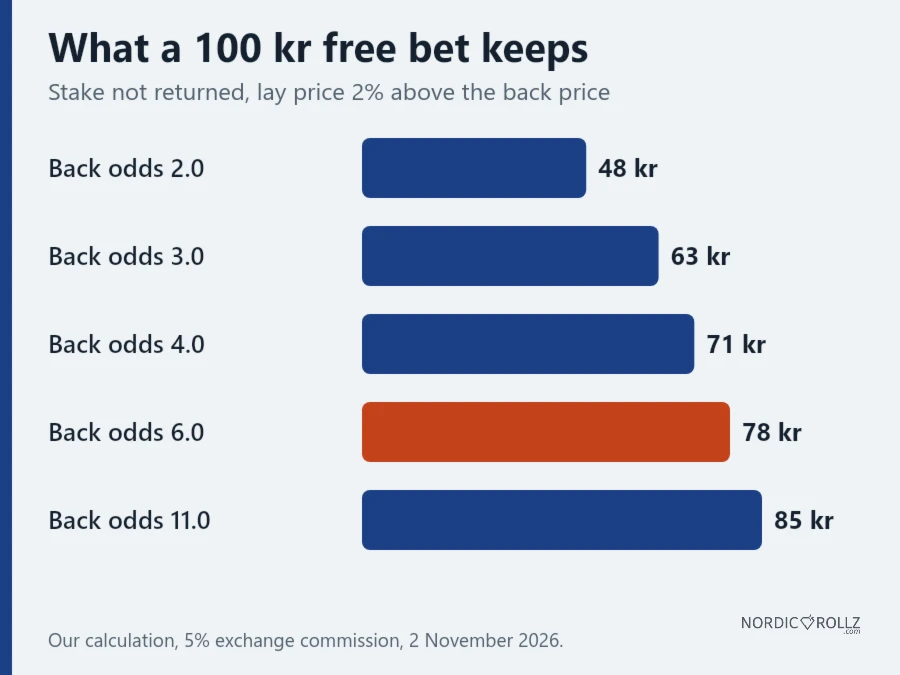
A stake-returned free bet is worth more, because the stake comes back with the winnings. At 5% commission and a lay price 2% above the back price, we get 95.48 kr per 100 at odds of 2.00 and 94.29 kr per 100 at odds of 4.00. The odds matter little here.
These are model figures from our own arithmetic, not results from real bets. Real prices move, and we placed no bets.
They cut the supply of free bets, and the effect differs by country. A bonus rule applies to a licence holder, so what you can claim depends on which licence the bookmaker holds. The table sums up what we read.
| Country | Bonus rule | What it means for matched betting |
|---|---|---|
| Sweden | A licence holder may offer a bonus only the first time a player plays one of its games (spellagen 14 kap. 9 §). Betting is covered (2 kap. 1 §). | One free bet per licence holder, first play only. No reload offers. |
| Norway | Bonus or free play, VIP programmes and similar personal financial incentives are banned for the regulated providers (pengespillforskriften § 11). | No bonus stream from regulated providers, so nothing to match. |
| Denmark | Promotion worth at most DKK 1,000, deposit or stake of 100% of the bonus, wagering at most 10x deposit plus bonus, at least 60 days (BEK 684/2025 § 22). | Bonuses are allowed beyond the first play, but the cap and the wagering limit the profit. |
| Finland | From 1 July 2027, only modest bonuses inside an established customer relationship, on equal terms, at most 5x wagering, not convertible straight to cash (Rahapelilaki sections 25, 26, 106). | Little room, and the 5x rule leaves a thin margin. |
| Iceland | In the sources we read, there is no licensing scheme a private operator could apply to. See our Iceland licence guide. | Nothing to add here. |
The details behind the rows come next. Each links to the text we read.
Sweden. A bonus is allowed only the first time a player plays one of the licence holder’s games. Spelinspektionen enforces it. On 29 April 2026 it issued a remark to Polar Limited for offering a bonus to several customers more than once. So a licence holder can’t send you a new free bet every month. See our Sweden licence guide.
Norway. Section 11 of the regulation bans bonus and free play for the regulated providers. That leaves matched betting with no bonus to match in Norway. See our Norway licence guide.
Denmark. The betting order sets the bonus rules for sportsbooks. Unlike the Swedish act, it doesn’t limit a bonus to the first play. It does say an offer must go to at least 100 players, and inactivity may not be a selection criterion. For commission-based games, wagering may be at most half the commission paid. See our Denmark licence guide.
Finland. The monopoly runs until the new act applies on 1 July 2027. After that, only modest bonuses are allowed. Read our Finland licence guide and the guide to the first Finnish gambling licences for the licence side.
For how the national sports betting rules fit together, see our sports betting regulation guide.
Often not, and at a Danish cap of 10x it is barely worth it. A bonus with wagering asks you to stake a multiple of deposit plus bonus before you can withdraw. If you match every wagering bet, each one costs a small loss, and those losses add up over the turnover.
Take our case: you deposit 1,000 kr and get 1,000 kr of bonus. Wagering of 10x on deposit plus bonus means a turnover of 20,000 kr. Every bet is matched at lay odds of 2.04 with 5% commission, so each one loses about 4.52% (4.5226% before rounding). The cost is about 905 kr, and the net is about 95 kr.
| Wagering multiple | Turnover (kr) | Cost at 4.5226% loss (kr) | Net of the 1,000 kr bonus (kr) | Break-even loss rate |
|---|---|---|---|---|
| 1x | 2,000 | 90 | +910 | 50% |
| 5x | 10,000 | 452 | +548 | 10% |
| 10x | 20,000 | 905 | +95 | 5% |
| 20x | 40,000 | 1,809 | -809 | 2.5% |
| 35x | 70,000 | 3,166 | -2,166 | 1.43% |
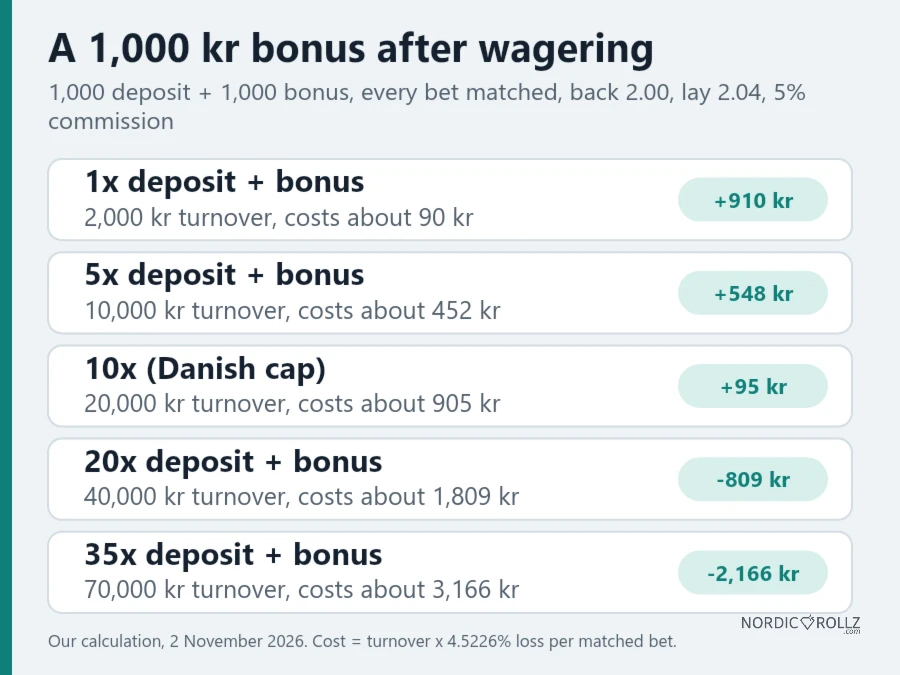
The break-even column tells the story. At 10x, the bonus only pays if your loss per matched bet stays under 5%. We used 4.52%, so there’s very little room. At 20x the limit falls to 2.5%, which our scenario already misses.
Read this table as an upper bound on the cost. It assumes you match every bet and complete the whole turnover. In practice you may lose less on some bets and more on others, and prices can move before you finish. At lower commission it improves: at 2% and a lay price of 2.04, the loss is 2.97% and the 10x net is +406 kr.
That’s why the Danish cap matters. The rule allows bonuses, but it limits wagering to 10x, so a bonus can still return something. The same 1,000 kr bonus at 20x would cost you money in the same scenario. Our casino sign-up bonus guide explains the wagering side of casino offers.
Finland’s 5x ceiling from 1 July 2027 is lower than the Danish one, but bonuses there must be modest, so the cash on offer will be small.
You need cash in two places at once, and time for every bet. The bookmaker holds your stake. The exchange holds your liability. At odds of 2.00 that’s about 103 kr in the exchange for each 100 kr bet. At odds of 8.00 on a free bet it’s 618 kr for each 100 kr, as the free-bet table showed.
Time is the quieter cost. The 10x case above has a turnover of 20,000 kr. At 100 kr a bet that’s 200 matched bets, each with two prices to check, and each a chance to make a mistake. By our arithmetic, the work grows linearly with the wagering multiple.
Put the two together and you get a method that needs a float and steady attention. It’s not “free money” in the way the phrase suggests.
Plenty, but most of it is cheap to avoid once you know about it. Four risks matter.
On limits, we found no Nordic operator clause that names matched betting, so we don’t claim one does. We did read related rules. Svenska Spel’s Kambi rules, section A 4.6, say arbitrage betting is not allowed and funds may be forfeited. The clause is about arbitrage, a different method, but it shows the kind of term you could meet.
For scale, the UK Gambling Commission wrote on 23 July 2025 that in 2024 4.31% of active accounts were restricted. That’s a UK figure for all restricted accounts, not just matched bettors. We cite it as context only.
As far as the rules we read go, nothing bans the player from backing and laying, and tax depends on your country. Norway keeps betting inside its exclusive-right model, with horse betting held by Norsk Rikstoto (see our Norway licence guide), so an exchange has no licence route there. We are not lawyers, and this is not tax advice. We looked at the tax rule in three countries.
Sweden. Skatteverket says winnings are tax free when the game needs a Swedish licence and the operator has one, or when it needs no Swedish licence and targets an EEA market. The page says nothing about exchanges. Our tax-free winnings guide covers the general rule.
Norway. Chance winnings are taxable above NOK 10,000 under skatteloven section 5-50. Skatteetaten also says targeted play of a certain scale is assessed case by case as possible business income. The factors include stakes, deposits and withdrawals, frequency, effort and duration. The principle statement of 3 July 2023 notes that the appeal cases concerned players who had not secured a guaranteed win. A matched bettor locks in a result, so ask Skatteetaten rather than guess.
Denmark. We did not verify an exchange-specific tax ruling, so we say nothing about it.
Run through these steps in order, and stop if any answer surprises you.
If you can’t tick every step, skip the bet. A bet you didn’t place can’t go wrong.
It’s not worth it when the rules, the odds or your time make the maths negative. The table of bonus costs shows how thin the margin gets at 10x, and how it turns negative at 20x.
Skip it if your country bans the bonus, if the wagering is above about 10x, or if the lay price is far from the back price. Skip it too if you can’t afford the liability on the exchange. And skip it if it turns into pressure to place more bets than you planned.
Matched betting still means opening gambling accounts and handling real stakes. If it starts to feel like a compulsion, our self-exclusion guide explains Spelpaus in Sweden and ROFUS in Denmark. Setting a deposit limit first is a sensible start.
For other sports betting terms, see our guides to Asian handicap and bet builders.
It’s backing an outcome at a bookmaker and laying the same outcome at an exchange, so the result is locked. The profit comes from free bets and bonuses, not from the bets.
No. A qualifying bet costs a small loss, and a free bet returns only part of its value. The profit comes only if the bonus is worth more than the losses.
Not with bonuses from the regulated providers, because section 11 of the regulation bans bonus and free play for them. That leaves nothing to match.
Only with the first bonus from each licence holder, since the Gambling Act allows a bonus only the first time a player plays one of its games.
A promotion worth at most DKK 1,000, with wagering at most 10x deposit plus bonus. In our arithmetic a matched 1,000 kr bonus nets about +95 kr at 10x with a loss of about 4.52% per bet.
You keep more of it, from 47.74 kr per 100 at odds of 2.00 to 85.05 kr at odds of 11.00 with 5% commission. But the liability grows from 52.26 kr to 914.95 kr.
Their terms let them limit or refuse bets. We found no Nordic operator clause naming matched betting. The UK Gambling Commission reported that 4.31% of active accounts were restricted in 2024.
It depends on your country. Sweden’s rule covers winnings from licensed operators, Norway assesses some cases as business income, and we did not verify a Danish exchange ruling.
We placed no bets and opened no accounts. All figures are our own arithmetic on stated prices, run on 2 November 2026, not results from real bets. We read the sources listed below between 18 October and 2 November 2026; the dates are next to each one.
What we could not verify: current exchange commission rates, the licence status of any exchange in the Nordic countries, any operator clause that names matched betting, and any tax ruling on exchange winnings. How we work is in how we rate.






New reviews, guides and bonus news by email. Unsubscribe at any time.

NordicRollz is an independent casino comparison site covering the Nordic market: Norway, Sweden, Denmark, Finland, and Iceland. Published by NordicRollz LTD, Malta, we research and rate operators on licensing, payment methods, and player protections. Our reviews are not paid placements. For full details on how we evaluate casinos, see our How We Rate methodology and our Advertiser Disclosure.
Publisher: NordicRollz LTD
Company Number: 154921
Registered Address:
Tower Business Centre,
Tower Street, BKR 4013 Swatar, Malta
You are in safe hands





New reviews, guides and bonus news by email. Unsubscribe at any time.