Pontoon Rules and Odds Explained: What Eight Rulebooks Say and What Each Rule Costs
Pontoon is two games under one name: a British home game where the banker wins ties, and a casino game played with the tens removed. We read eight regulator and casino rulebooks, price each rule set with our own calculation and show which rules move the odds most.
Home > Guides > Game Rules and Odds > Pontoon Rules and Odds Explained: What Eight Rulebooks Say and What Each Rule Costs
Pontoon is a blackjack-family card game: get closer to 21 than the dealer without going over. But the name covers two games. In the British home game, the banker wins every tie. In the Australian, New Zealand and Singapore casino rules we read, the four tens are removed from every deck and bonuses pay you back for it. With good play, our calculation puts that version at a house edge of about 0.9% under the Canberra rulebook.
We compare eight rulebooks, from the Australian Capital Territory to Singapore and Massachusetts: seven from regulators and one casino leaflet. Our own calculation prices each rule, and a basic strategy table follows. None of the usual pontoon guides we read names a rulebook or puts a number on a rule. We read every source on 17 October 2026. NordicRollz is a Nordic team based in Malta.
Last updated: 18 October 2026
Casinos with a live casino
The tiles below come from our live casino category. The tag means our review found a live casino at that site. It doesn’t tell you which tables or rules a site offers, and the order isn’t a ranking.
Pontoon is a “banking” card game: one player or the casino holds the bank, and everyone else plays against it. The aim is the same as in blackjack. Get a hand total closer to 21 than the bank’s. Go over 21 and you’re “bust”, so the hand loses at once.
The best hand is a “pontoon”: an ace and a ten-value card as your first two cards. In blackjack, the same hand is simply a blackjack. The name comes from the French vingt-et-un (“twenty-one”), the game family that blackjack belongs to as well. The card game site Pagat describes pontoon as the British version of that family and says the name is derived from the French.
Which pontoon? Two quite different games use the name today:
The British home game. A player acts as banker and keeps their cards hidden. The banker wins all ties, and a “five card trick” (five cards that don’t go over 21) beats everything except a pontoon. We found no official regulator rulebook for it, and Pagat lists many house variations.
Casino pontoon. A dealt table game approved by a gambling regulator. It uses 48-card decks (the four tens are taken out), ties are a push, any 21 wins and special hands pay bonuses. In the United States a close relative is sold as Spanish 21, and Massachusetts calls its version “Pontoon 21”.
Why does the casino version remove the tens?
Tens are good cards for you. Take the four tens out of each deck (the jacks, queens and kings stay in) and there are fewer ten-value cards. So you get fewer pontoons and fewer strong hands. On its own, our calculation shows this one change adds about 1.8 percentage points to the house edge.
The casino then gives most of that edge back through player-friendly rules. Any 21 wins. Five or more cards earn bonus payouts. You can double on any number of cards, and you can “rescue” a doubled bet. How much is each of those rules worth? That’s the rest of this guide.
Place your bet. The bet goes down before any cards are dealt. Optional side bets, such as Perfect Pairs, go in their own betting areas.
The deal. You get two cards face up. The dealer gets one card face up and no second card yet: rule 6.2 of the Canberra rules gives the dealer a single card in the first deal.
Pontoon is paid at once. If your first two cards are an ace and a jack, queen or king, you’re paid 3 to 2 straight away, “regardless of the value of the dealer’s first card” (rule 8.1).
Surrender or insurance. If the dealer’s card is an ace or a picture card, you may surrender half your bet. But if the dealer then makes a pontoon, the surrender is cancelled and you lose the whole bet (rule 9.3). Against an ace you may also take insurance, which pays 2 to 1.
Playing your hand
Play your hand. You may hit (draw a card), stand, split a pair or double. If your hard total is under 12, you must keep drawing unless you double (rule 10.2(c)). A hand that reaches 21 stops there and is paid at once (rule 10.2(b)).
Double down on any number of cards. You may double on your first two cards, or on any later hand with a total under 21 (rule 12.1). You add up to your original bet and get exactly one more card. An ace in the first two cards of a doubled hand counts as one (rule 2.5).
Rescue a double if you want. After the extra card, you may give up your original bet and take back the doubled part, as long as the hand hasn’t gone over 21 (rule 12.6).
The dealer draws. Once every player has finished, the dealer draws the second card. The dealer keeps drawing on a hard 16 or less and on a soft 17 (rule 13.1). A soft hand is one where an ace counts as 11.
Settlement. The higher total wins 1 to 1, equal totals are a “stand off” (a push), and special hands are paid from the pay table.
Card values
Two to nine count their face value. The ten itself isn’t in the deck.
Jack, queen and king count 10.
An ace counts 1 or 11, whichever is better for the hand (with the doubling exception in step 6).
What does pontoon pay? The Canberra pay table
Every casino rulebook we read uses the same main pay table. Here is the version from Table 1 of the Canberra rules:
Hand
Pays
Pontoon (ace and a picture card as the first two cards)
3 to 2
Five cards totalling 21
3 to 2
6, 7, 8 in mixed suits
3 to 2
7, 7, 7 in mixed suits
3 to 2
Six cards totalling 21
2 to 1
6, 7, 8 of the same suit (not spades)
2 to 1
7, 7, 7 of the same suit (not spades)
2 to 1
Seven or more cards totalling 21
3 to 1
6, 7, 8 all spades
3 to 1
7, 7, 7 all spades
3 to 1
All other winning bets
1 to 1
Three details matter for the odds. First, bonuses are never paid on a doubled hand. Rule 12.7 says: “All winning doubled hands shall be paid at odds of 1 to 1”. Second, a pair of aces or picture cards that you split cannot make a pontoon (rule 11.7).
Third, three 7s of the same suit earn a “Super Bonus” when the dealer’s first card is also a 7. In Canberra it pays $1,000 on a bet under $25 and $5,000 on $25 or more, and everyone else at the table gets $50. It’s a fixed cash prize, not odds, so we left it out of our percentages.
The British home game: twist, stick and the five card trick
Learned pontoon at home? Then you learned the British banking game. Pagat’s rules give the shape most players know:
Banker. The banker deals one card face down to each player and to themselves. Players bet, then a second card goes round. The banker’s cards stay hidden.
Twist and stick. “Twist” means take a card face up. “Stick” means stand. You may not stick on a total under 15.
Buy. Instead of twisting, you may “buy” a card face down by adding to your bet. In Pagat’s rules you add between one and two times your first stake.
Five card trick. Five cards that total 21 or less beat every hand except a pontoon.
Ties go to the banker. If your total equals the banker’s, the banker wins. One rule, and it’s the biggest difference from the casino game.
Payouts. A pontoon or a five card trick is usually paid double (2 to 1), other wins even money.
How the home game favours the banker
The banker wins ties and acts last, so the home game strongly favours the banker. We modelled one version. The banker always stands on 17 or more. Ties and pontoons go to the banker. A player pontoon or five card trick is paid 2 to 1.
In our version, a banker pontoon collects only a single stake from each player. Pagat lists that single stake as a variation. In Pagat’s main rules the banker collects double, which would raise the banker’s edge to about 8.6% in our model.
We also left out buying and the banker’s own five card trick. The single-stake version gives the banker an edge of about 4.9%. House rules vary a lot, and a banker who chooses freely when to stop can do better or worse, so treat that figure as an illustration. In a home game, the bank usually passes to a player who makes a pontoon, which spreads the advantage around the table.
The Nordic countries have their own home games of twenty-one from the same vingt-et-un family, with their own card values and rules. They’re cousins of pontoon, not the same game.
How does pontoon differ from blackjack?
Here is what casino pontoon changes compared with the rules in our blackjack guide:
Feature
Casino pontoon (Canberra)
Typical blackjack (see our blackjack guide)
Decks
3 to 8 decks of 48 cards, tens removed
1 to 8 decks of 52 cards
Dealer’s second card
Dealt after the players finish
Usually dealt face down at the start
Dealer on soft 17
Hits
Stands or hits, by table
Your two-card 21
3 to 2, paid at once
3 to 2 (6 to 5 on some tables)
Any other 21
Always wins, paid at once
Can tie a dealer 21
Bonuses for 5, 6, 7+ cards
Yes, 3 to 2 to 3 to 1
No
Doubling
Two cards or any later hand under 21
Usually two cards only
Rescue of a double
Yes
No
Surrender
Half, against an ace or picture card
Varies, often none
The two games feel similar, but the strategy isn’t the same. With fewer tens, the dealer busts less often on a 2 to 6. So you’ll hit many hands in pontoon that you’d stand on in blackjack. The strategy table below shows how far that goes.
Pontoon vs Spanish 21
Spanish 21 is the American name for the same idea: 48-card decks plus bonuses. The rules we read in New Jersey, Pennsylvania and Massachusetts share the pay table above. They differ from Australian and Singapore pontoon in three main ways:
The dealer stands on soft 17. All three US rulebooks have the dealer stop drawing at a hard or soft 17. In our calculation, that alone is worth about 0.44 percentage points to you.
A dealer blackjack beats your multi-card 21. In Massachusetts, a bet loses “if the player has 21 in more than two cards and the dealer has a blackjack”. In Canberra, your 21 is paid before the dealer draws, so it can’t lose.
Surrender against any dealer card. Massachusetts and New Jersey let you give up half your bet against any first card. If you surrender, the dealer collects the whole bet only if they hold a blackjack against an ace or picture card.
What the rulebooks say: eight versions compared
We read the official rules for casino pontoon and Spanish 21 in eight places. Five are regulator-approved pontoon rules: the ACT, New Zealand, two from Singapore and Massachusetts. Two are US Spanish 21 regulations, and one is a casino’s own leaflet.
Rulebook
Dealer soft 17
Doubling
Dealer pontoon against your split hands
Published house edge
Canberra, ACT (NI2018-569, 2018)
Hits
Two cards or any later hand
Takes the original bet only
None
New Zealand (Gazette, 12 May 2000)
Hits
Two cards or any later hand
Original bet only
None
Singapore, Marina Bay Sands (version 6, 2019)
Hits
First two cards only
Not stated
None
Singapore, Resorts World Sentosa (version 5, 2019)
No regulator in the eight documents publishes a house edge or a return to player for pontoon.
Pontoon odds and house edge: how do the rule sets compare?
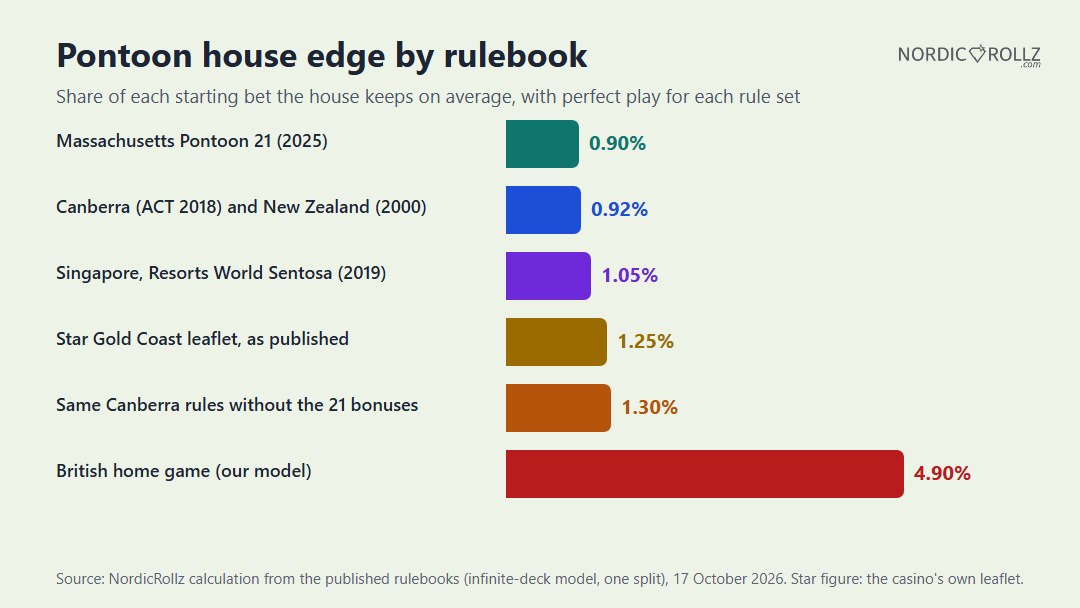
To put numbers on the rulebooks, we wrote our own calculator. It works out the best decision for every hand against every dealer card, then averages the result over all deals. Each row shows what share of your starting bet the casino keeps on average, assuming perfect play:
Rule set
House edge (our model)
Massachusetts Pontoon 21 (2025)
0.90%
Canberra (2018) and New Zealand (2000)
0.92%
Star Gold Coast (rescue only up to 20)
0.92%
Singapore, Resorts World Sentosa (2019)
1.05%
Canberra rules without the 21 bonuses
1.30%
Plain blackjack in the same model (52 cards, dealer hits soft 17, no hole card)
0.90%
British home game (banker stands on 17, banker pontoon collects one stake, no buying)
about 4.9%
Keep three limits in mind when you read these:
The model treats the shoe as endless. Real tables use 3 to 8 decks, and every card dealt changes the odds a little.
It allows one split per hand. The rulebooks allow up to three or four hands, which helps you slightly.
It leaves out the fixed-cash Super Bonus, insurance and every side bet.
Treat the absolute numbers as upper estimates, and trust the differences between rule sets more than the levels. The first two limits should make our figures a little higher than the true value, and leaving out the Super Bonus does the same. We didn’t test how large the shoe effect is.
The Massachusetts figure assumes the dealer’s second card is dealt after the players finish, which its rules allow. With the hole-card check it would be about 0.89%.
Two results stand out. First, a well-played casino pontoon costs about the same as ordinary blackjack under similar dealer rules: the player-friendly rules and bonuses almost exactly pay back the missing tens. Second, the Star leaflet’s “generally 1.25%” sits above our figure for the same rules. That fits a casino averaging over how real players play, not perfect play, but the leaflet doesn’t say.
What does that cost per hour?
Expected loss is stake × hands × house edge. Say you play €10 a hand at an assumed 60 hands an hour: you stake €600. At 0.92%, the average cost is about €5.50 an hour. That’s only an average, though. Our house edge guide shows how short sessions can swing far above or below it.
What is each pontoon rule worth?
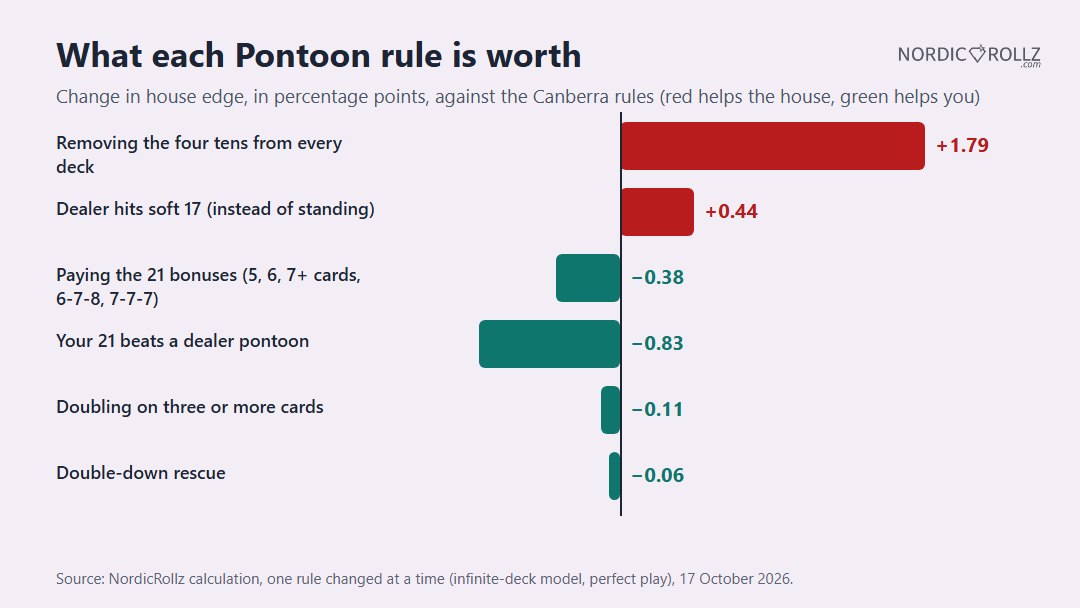
Start from the Canberra rules and change one rule at a time. This is how the house edge moves (positive numbers help the house):
Rule change against the Canberra rules
Change in house edge
Put the four tens back in every deck
about 1.79 points lower (the player would have the edge)
Dealer stands on soft 17 instead of hitting
0.44 points lower
Your 21 can lose to a dealer pontoon
0.83 points higher
Remove the 21 bonuses (5, 6, 7+ cards, 6-7-8, 7-7-7)
0.38 points higher
Doubling on the first two cards only
0.11 points higher
No rescue of a doubled bet
0.06 points higher
No surrender
almost no change
So what does that mean at the table? Three practical points:
“Any 21 wins” is the most valuable player rule. If your multi-card 21 can lose to a dealer pontoon, as in the US rulebooks, you give back more than all the card bonuses are worth.
Soft 17 matters. A table where the dealer stands on soft 17 is clearly better for you. All the Australian and Singapore rulebooks we read have the dealer hit soft 17, and all three US rulebooks have the dealer stand.
Surrender is nearly worthless here. Because the dealer has no second card yet, a surrender is cancelled when the dealer goes on to make a pontoon. That takes away almost all its value. If the surrender weren’t cancelled, our model values it at about 0.15 points.
Pontoon basic strategy for the Canberra rules
This table shows the best first decision on your first two cards under the Canberra rules, from our calculation. H = hit, S = stand, D = double, P = split. The dealer’s card is the column. Under these rules, surrender never came out as the best play on a two-card hand.
The totals in the table are for hands that cannot grow into a 6-7-8 bonus. The bonus changes the play in three cases. With a 6 and a 7 (13) you hit against every dealer card. With a 6 and an 8 (14) you hit against everything except a 6. With a 7 and an 8 (15) you hit against a 2 or a 3.
Your hand
2
3
4
5
6
7
8
9
J/Q/K
A
Hard 9 or less
H
H
H
H
H
H
H
H
H
H
Hard 10
H
H
H
H
D
H
H
H
H
H
Hard 11
D
D
D
D
D
D
D
D
D
D
Hard 12
H
H
H
H
H
H
H
H
H
H
Hard 13
H
H
H
H
S
H
H
H
H
H
Hard 14
H
H
S
S
S
H
H
H
H
H
Hard 15 and 16
S
S
S
S
S
H
H
H
H
H
Hard 17
S
S
S
S
S
S
S
S
S
H
Soft 13 to soft 17
H
H
H
H
H
H
H
H
H
H
Soft 18 (A and 7)
S
S
S
S
S
S
S
H
H
H
Soft 19 or more
S
S
S
S
S
S
S
S
S
S
Pair of 2s
H
P
P
P
P
P
P
H
H
H
Pair of 3s
H
P
P
P
P
P
P
H
H
H
Pair of 6s
H
H
H
P
P
H
H
H
H
H
Pair of 7s
P
P
P
P
P
P
H
H
H
H
Pair of 8s
P
P
P
P
P
P
P
P
P
H
Pair of 9s
S
P
P
P
P
S
P
P
S
S
Pair of aces
P
P
P
P
P
P
P
P
P
H
How this differs from blackjack:
You hit far more often. Fewer tens mean you bust less, and a hand that reaches five or more cards with 21 pays a bonus.
You double less often on the first two cards. Canberra lets you double later on any total under 21, so with a 10 it usually pays to take a card first and keep the double for later.
The table covers the first decision only. After three or more cards the best play changes. In our model a three-card hard 11 is still doubled against every dealer card, and a four-card hard 11 against some of them.
Other rules, other table. Under Singapore or US rules the table changes, mostly on soft 17 and doubling.
Pontoon side bets
Most rulebooks add optional side bets. The pay tables are printed, but none of the documents publishes the probability or return, so we haven’t priced them:
Perfect Pairs (Canberra): a mixed pair pays 6 to 1, a coloured pair 12 to 1 and a perfect pair 25 to 1. The Star Gold Coast leaflet pays 5, 10 and 25 to 1 on the same bet.
Pair bet (Singapore): any pair as your first two cards pays 11 to 1.
Pontoon Pandemonium (Resorts World Sentosa): pays a random multiplier from 2x to 100x when you get a pontoon. The rules list the multipliers but not how often each comes up.
Match the dealer (New Jersey): pays when either of your first two cards matches the dealer’s up card, from 3 to 1 to 12 to 1 depending on the number of decks and suits.
A side bet is a separate wager with its own, usually higher, house edge. If the casino doesn’t publish the return, you can’t know what it costs.
What does this mean for Nordic players?
Pontoon isn’t a common game in the Nordic markets. We didn’t find it on any Nordic operator’s public game list or return table that we could read. We also found no Nordic regulator register of approved table games.
Denmark
Danske Spil prints return percentages for the live tables it offers on its winning chances page. Live blackjack returns 99.28% there. Pontoon isn’t on the list. The same page says the win chances for casino games are given in the individual game guides. We didn’t check those.
Sweden
On the Svenska Spel online casino pages we could read we saw several blackjack variants and no pontoon or Spanish 21. We couldn’t read the full game list. Its land casino, Casino Cosmopol in Stockholm, has closed. Svenska Spel’s page says it closed permanently from 25 April, after an instruction from the government that it should be wound down. The page was published in July 2025.
Norway, Finland and Iceland
Norsk Tipping’s KongKasino rules sit in chapter 6.2 of its customer terms, as its help page says. We couldn’t read a game list there, so we can’t say whether pontoon is offered. The same goes for the game lists of Veikkaus in Finland and of the Icelandic operators: we couldn’t read those either. If you see pontoon at an online casino, it’s probably a supplier’s version. Check its help screen for the rules and the return figure before you play.
What to take from the rulebooks
You may never sit at a table in Canberra or Singapore, but the comparison still shows you what to look for online. Five rules matter: tens removed or not, dealer on soft 17, whether any 21 wins, when you may double, and what the bonuses pay. Together they decide whether a pontoon game is a fair deal.
How to check a pontoon game before you play
Read the game’s rules or help screen. Online versions differ from casino pontoon, and some follow the British home rules.
Check the deck. Are the tens removed? If they are, the bonuses must make up for it.
Check the dealer’s soft 17 rule. Standing on soft 17 is worth about 0.44 points to you in our model.
Check that any 21 wins. If a dealer pontoon beats your 21, the game costs you about 0.8 points more.
Check who wins a tie. If the dealer or banker wins ties, as in the home game, the house edge is several times higher.
Look for a published return (RTP). A return of 99% or more is in line with casino pontoon played well. Nothing published means you can’t compare.
Skip side bets you cannot price.
Set a budget first. Our responsible gambling page lists the limit tools and helplines in each Nordic country.
Player protection: what to do if something goes wrong
In Canberra, the approved rules say the casino’s decision in a dispute is final (rule 17.4). The ACT Gambling and Racing Commission can review it if requested. Playing online instead? Start with the rules shown in the game and the operator’s terms. Then find out which authority licenses the operator: our Casino Licences hub shows who that is. You can compare operators with our casino list and how we rate casinos.
Advantages and limitations
Advantages of casino pontoon:
A low house edge when played well, about the same as blackjack under similar rules.
More choices than blackjack: doubling later in the hand, rescue and bonuses.
Any 21 wins, so it’s worth going for long hands.
Limitations:
The strategy differs from blackjack, so a blackjack chart played at a pontoon table costs you money.
Hard to find in the Nordics, and online versions differ from the casino rules.
No regulator publishes a house edge, so you depend on the rules being shown and on outside calculations.
The British home game is a very different deal for the player: ties go to the banker.
Frequently asked questions
What is pontoon?
Pontoon is a blackjack-family card game: you try to beat the dealer or banker by getting closer to 21 without going over. In casinos it’s played with the tens removed and pays bonuses for five-card 21s and similar hands. At home it’s the British banking game where the banker wins ties.
How do you play pontoon?
You bet, get two cards and then hit, stand, double or split. In the casino version the dealer draws a second card only after the players finish. A pontoon (ace plus picture card) pays 3 to 2 at once, and any 21 wins.
What is the difference between pontoon and blackjack?
Casino pontoon removes the four tens from each deck and pays bonuses for five or more cards and special 21s. It lets any 21 win and allows doubling later in the hand. In the British home game, the banker also wins all ties.
What is a five card trick in pontoon?
In the British home game, a five card trick is five cards totalling 21 or less. It beats every hand except a pontoon and usually pays double. In casino pontoon, five cards only pay a bonus (3 to 2) when they total exactly 21.
What are the odds in pontoon?
Under the Canberra rulebook, our calculation gives a house edge of about 0.9% with perfect play. The Star Gold Coast leaflet says “generally 1.25%”. The British home game, where the banker wins ties, gives the banker an edge of several percent.
Who wins a tie in pontoon?
In the casino rulebooks we read, equal totals are a push and your bet is returned. In the British home game, the banker wins ties.
Is pontoon the same as Spanish 21?
They’re close relatives. Both use 48-card decks and the same bonus pay table. The US Spanish 21 rules have the dealer stand on soft 17. A dealer blackjack beats your 21 made with three or more cards.
Can you play pontoon at Nordic casinos?
We didn’t find pontoon on any Nordic state operator’s public game list or return table that we could read. Online versions exist at some casinos as supplier games. Check the rules and return figure in the game before you play.
Recent changes
17 October 2026: first version, built on eight rulebooks and our own calculation.
The newest rulebook we read is Resorts World Sentosa’s “Pontoon Plus” (version 6, in force from 13 February 2026). It keeps the main pontoon rules and adds four new side bets.
How we verified this
We read the Canberra rulebook, the Massachusetts Pontoon 21 rules, the Resorts World Sentosa rules and the Star Gold Coast leaflet in full. We checked the quoted rules against the PDF text. The New Zealand, Marina Bay Sands, New Jersey and Pennsylvania rules were read by our researcher with clause numbers recorded. The New Jersey text was read through Cornell’s Legal Information Institute, which republishes the state’s administrative code. The house edge figures come from our own calculator. It finds the best play for every hand against each dealer card. Given blackjack rules, it reproduces the standard blackjack basic strategy on the hands we checked. The full chart for standard blackjack is in our blackjack strategy chart.
What we could not verify
Rulebooks for the other Australian states and territories (Victoria, New South Wales, Queensland, South Australia, Western Australia, Northern Territory, Tasmania). We found no published pontoon text.
The rules and return of online pontoon games from suppliers. We found no official supplier page.
Whether any Nordic-licensed online casino offers pontoon today.
Whether pontoon is on the game lists of Norsk Tipping, Veikkaus, Svenska Spel’s online casino and the Icelandic operators (their lists could not be read).
Whether the Star Gold Coast leaflet is the current version (it is undated and we found it only as a copy on another site).
Whether later ACT approvals have replaced the 2018 instrument. The register showed it as in force on 17 October 2026.