Prediction Markets in the Nordics: Is Polymarket Legal, and What Each Regulator Says
Prediction markets such as Polymarket and Kalshi sell shares in future events. We read the Nordic regulators’ own documents: Denmark has blocked Polymarket, Norway has named both sites in a block notice, and Sweden says Polymarket is not aimed at Swedes. Plus the price and fee maths.
Prediction markets like Polymarket and Kalshi hold no licence in any Nordic country that we could find. Denmark already blocks Polymarket by court order. Norway’s regulator has put both Polymarket and Kalshi on a list of 62 sites it is considering blocking. We found no action against them in Sweden, Finland or Iceland.
So is it legal? It depends on where you live and whose rules you read. This guide takes each Nordic country in turn, quotes the regulators’ own documents and shows what a price really implies. It also shows what a trade costs you in fees.
Last updated: 20 October 2026
The short version
No prediction market holds a Nordic gambling licence. Treat them as unlicensed gambling sites.
Denmark has blocked polymarket.com since August 2026, after a court ruling in July.
Norway named Kalshi.com and Polymarket.com in a block notice dated 17 September 2026.
Sweden says Polymarket isn’t aimed at Swedes, so it hasn’t stepped in.
A price of 30 cents means the market thinks there’s a 30% chance. Fees come on top.
What is a prediction market, and how does the price work?
A prediction market lets you buy shares in the outcome of a future event. Will it rain in Oslo on Saturday? Who wins the next election? Each share pays 1 dollar if the outcome happens and nothing if it doesn’t.
A price is a crowd’s guess at the probability. A YES share at 30 cents says the market puts the chance at about 30%. Betting odds say the same thing in another format, and our odds converter shows the percentage behind any of them. So ask: what chance does that price imply, and do you disagree? If you think the real chance is higher, you buy. If you think it’s lower, you sell or buy NO. A sportsbook price hides a margin too, and our overround calculator shows how much.
Here’s a worked example. Say you buy 100 YES shares at 30 cents, so you pay 30 dollars. If the event happens, you get 100 dollars back and your profit is 70 dollars. If it doesn’t, you lose the 30 dollars.
You break even only if the event happens more often than 30% of the time. Fees push that line a little higher. More on that further down.
Who are you trading against?
You trade against other users, not against the house. Polymarket says every pair of YES and NO shares is backed by 1 dollar, and you can sell before the event is settled. Sounds like a stock market, right? The regulators we read in Norway, Denmark, France, the Netherlands and the UK treat it as betting. The rest of this guide turns on that point.
Is Polymarket legal in the Nordics?
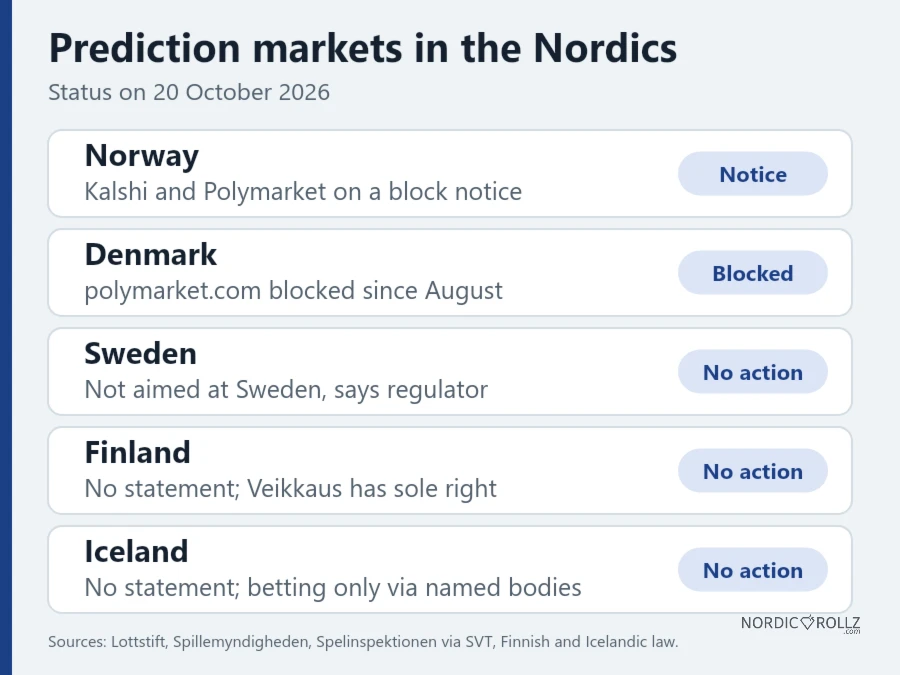
Polymarket and Kalshi hold no licence from any Nordic regulator. In Norway and Denmark the regulators treat them as unlicensed gambling and act against them. In Sweden the regulator’s test is whether the site targets Swedes, and it says Polymarket doesn’t. Finland and Iceland have said nothing about them that we could find.
Country
Status of prediction markets (20 October 2026)
Who decides
Norway
Kalshi.com and Polymarket.com named in a DNS block notice of 17 September 2026; no final order seen yet
Lottstift (Norwegian Gaming Authority)
Denmark
polymarket.com blocked by Danish internet providers after a court ruling of 8 July 2026
Spillemyndigheden and the Frederiksberg court
Sweden
No action; the regulator says Polymarket is not aimed at the Swedish market
Spelinspektionen
Finland
No statement found; only Veikkaus may offer betting until a licence system starts on 1 July 2027
National Police Board
Iceland
No statement found; betting is lawful only for bodies named in Icelandic law
Ministry of Justice
One thing surprises people. Polymarket’s own list of restricted countries names France, Germany, Italy, Poland, Belgium, the UK and the US, but no Nordic country. So the Nordic blocks don’t come from Polymarket. They come from the regulators and the internet providers.
Why are Polymarket and Kalshi on Norway’s block list?
Because Norway’s regulator thinks they offer gambling to Norwegians without permission. On 17 September 2026 Lottstift sent all Norwegian internet providers a notice of a planned DNS block of 62 sites. Kalshi.com is number 29 on the list and Polymarket.com number 42.
We read the whole ten-page notice. As far as we could tell, Kalshi and Polymarket are the only prediction markets on it. The other 60 names look like casino and betting sites, such as Stake.com, Betway.com and Coolbet.com. The notice gives no separate reasoning for prediction markets. They get the same test as everyone else.
What test does Lottstift use?
Two questions decide it. Is it a money game, and is it aimed at Norway? The notice defines a money game as one where you stake money, you can win a prize of economic value, and the result is wholly or partly down to chance. A share in an election outcome fits that wording without much stretching.
For “aimed at Norway”, the notice lists signs such as Norwegian language, Norwegian kroner, a +47 phone code at registration, Norwegian marketing and Norwegian customer support. It also says Lottstift picked sites partly from internet traffic from Norway, tips from the public and other countries’ regulators.
Is the block in force?
Not yet, as far as we can see. The notice says in plain words that it is only advance notice. Providers must not block anything on the strength of it.
The deadline for comments was 15 October 2026. A block order takes effect at least seven weekdays after a decision, and the final list may differ from the notice.
Lottstift’s page on blocked sites says DNS blocking started on 1 January 2025 and that 238 sites have been blocked so far. It mentions the September notice of 62 new sites, but when we checked on 20 October it did not yet show a decision on them.
What did the regulator say in public?
Lottstift’s director, Atle Hamar, told E24 on 8 October 2026 that such sites are perfect for insider trading, and that the authority doesn’t want that (our translation). In Parliament, four members tabled a proposal on 1 June 2026. It asks the government to look into regulating prediction markets, including whether and how far they should be covered by the Gambling Act (Document 8:297 S).
What does a DNS block mean for you?
A DNS block makes the site’s name stop working for customers of Norwegian internet providers, and the regulation behind it requires a landing page. That page tells you the site has been blocked by Norwegian authorities and that you have done nothing illegal by looking it up. The law targets whoever offers the game, not you. Our Norway licence page explains how the system works.
The authority’s own news page doesn’t name Polymarket. DR reported on 19 August 2026 that the case was brought against Telenor. The same report says the other providers follow the ruling under their industry code. It adds that Polymarket said it was disappointed and would challenge the block.
Spillemyndigheden has blocked 870 sites since 2012, by its own count. A blocked site in Denmark is a site the authority considers to be offering gambling without a Danish licence. Our Denmark licence page has the rest of the Danish system.
Why hasn’t Sweden acted?
Because Sweden’s test is targeting, and the regulator says Polymarket doesn’t target Swedes. The Swedish Gambling Act defines betting as staking on the outcome of a future event, and betting needs a licence. On paper, that’s a prediction market.
But the same Act says an online game that isn’t aimed at the Swedish market doesn’t count as offered in Sweden. A Spelinspektionen spokesperson told SVT on 31 May 2026 that it doesn’t consider Polymarket to be aimed at Sweden, since it has no Swedish text and no Swedish currency. A ban wasn’t on the table, according to the same report.
Does that make it safe to use from Sweden? Not in any protective sense. An unlicensed site isn’t covered by Spelpaus, by Swedish deposit limits or by the Swedish complaints route. Our Sweden licence page covers those protections.
What about Finland and Iceland?
Neither country has said anything about prediction markets that we could find. The general rules still apply, though.
Finland
In mainland Finland, the state company Veikkaus has the sole right to offer betting until the end of June 2027. A new Gambling Act opens betting and online casino games to licensed operators from 1 July 2027.
Finland has payment blocks for unlicensed gambling, in force since the start of 2023. Polymarket’s deposits run in crypto, so how far a bank payment block reaches here is an open question. The details are on our Finland licence page.
Iceland
Iceland allows betting only through bodies named in its own laws, such as the sports pools company Íslenskar getraunir. We found no DNS blocking and no payment ban for foreign gambling in Icelandic law. Our Iceland licence page lists the named bodies and the laws behind them.
How does the rest of Europe treat prediction markets?
As gambling, at least in the three countries we looked at. Their regulators have acted, and none of them has called it investing.
Netherlands: the Kansspelautoriteit issued a sanction decision on 20 January 2026 against Adventure One QSS Inc., the company behind polymarket.com. The regulator’s inspector had placed a 1 dollar bet on who would become the next Dutch prime minister.
United Kingdom: the Gambling Commission wrote in February 2026 that current products appear to fall within the definition of a betting intermediary, depending on the business model. It also wrote that operating without a licence can be a criminal offence.
That US status doesn’t travel. A licence or designation in one country says nothing about whether a site may serve players in another. We make the same point about casino licences in our guide to casino licences.
What does a prediction market cost you?
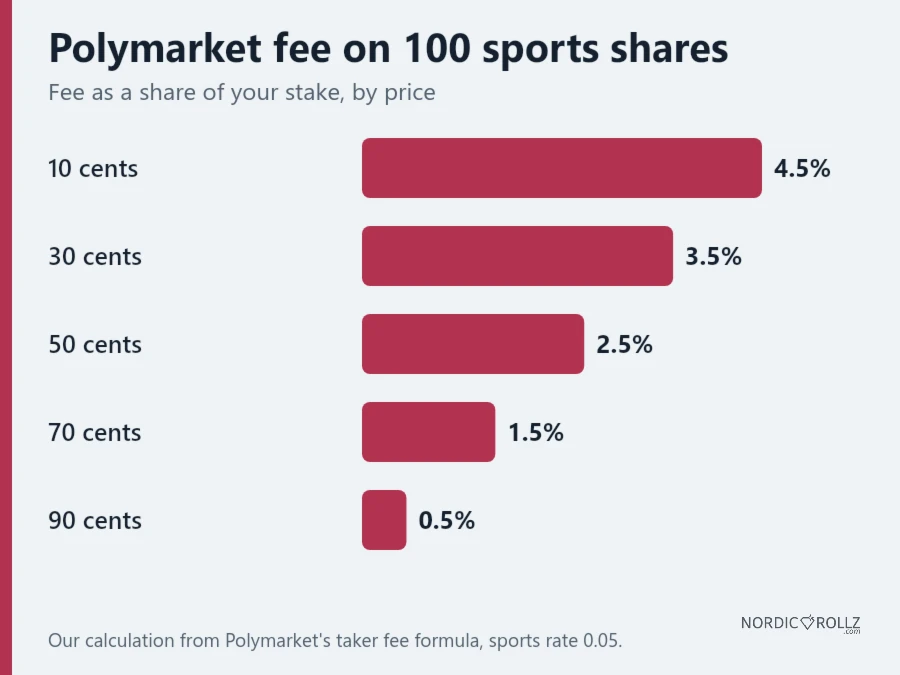
The fee is small per share, but it’s biggest, as a share of your stake, on cheap long shots. Polymarket publishes its taker fee formula: number of shares, times the category’s fee rate, times the price, times one minus the price.
The fee rate is 0.05 for sports markets, 0.04 for politics and 0.07 for crypto. Geopolitics and world events are free. If your order rests in the book and someone else fills it, you’re a maker and pay nothing.
Here’s what that means for 100 shares in a sports market, at five prices. The fee figures are our own calculation from Polymarket’s formula.
Price per share
You pay for 100 shares
Fee (sports, 0.05)
Fee as share of stake
Break-even chance
0.10 USD
10 USD
0.45 USD
4.5%
10.45%
0.30 USD
30 USD
1.05 USD
3.5%
31.05%
0.50 USD
50 USD
1.25 USD
2.5%
51.25%
0.70 USD
70 USD
1.05 USD
1.5%
71.05%
0.90 USD
90 USD
0.45 USD
0.5%
90.45%
See the pattern? The fee in dollars peaks at 50 cents. As a share of what you put in, though, it’s heaviest on the long shot. A 10 cent share needs the event to happen 10.45% of the time just to break even, not 10%. And that’s before the spread between the buy and sell price, which can cost you more than the fee.
Polymarket says it charges no fee to deposit or withdraw USDC, but the services that sell you USDC may charge their own. A bank card, an exchange and a crypto transfer can each take a slice before you’ve placed a single trade. Our guide to house edge shows how the same kind of small cut adds up in casino games.
Is the crowd’s price a fair price?
Often it’s a decent guess. But a price isn’t a fact. Thin markets with few traders can sit far from the real chance for a long time. And if someone knows more than you, you’re paying for their knowledge. That’s exactly the insider trading worry Norway’s regulator raised.
Are prediction markets gambling or investing?
The regulators we read in Norway, Denmark, France, the Netherlands and the UK keep landing on gambling. Norway’s notice applies the plain money game test: a stake, a prize of economic value and a result that depends wholly or partly on chance. The Dutch decision describes Polymarket as a virtual version of betting on events. The UK puts it next to betting exchanges.
The platforms see it differently. Polymarket told DR that it doesn’t take positions and doesn’t profit from outcomes, which is close to how the UK Gambling Commission describes a betting exchange. You trade against other users, so the platform isn’t the bookmaker. That’s a real difference from a sportsbook, but it hasn’t changed any Nordic regulator’s view so far.
If you already know arbitrage betting, you’ll recognise the logic. When a price on one site is out of line with odds elsewhere, someone trades the gap. That’s the same maths, just with shares instead of decimal odds.
Do you pay tax on prediction market winnings?
We found no Nordic tax authority guidance that mentions prediction markets by name. Norway’s tax agency says winnings over NOK 10,000 from commercial foreign gaming are taxable, with online casinos as its example. We couldn’t find an answer on whether a Polymarket payout counts as gaming, as crypto or as both.
Our guide to tax on winnings covers the rules in each country. If the amounts matter, ask the tax office before you file.
What are the pros and cons?
What prediction markets do well:
The price is a number you can read as a probability, which beats vague odds talk.
You can sell before the event and lock in a gain or cut a loss.
Fees are published as a formula, and some categories are free.
What you give up:
No Nordic licence, so no Nordic complaints route and no self-exclusion that covers them.
Deposits go through crypto, with costs and risks of their own.
In Denmark the site is blocked, and in Norway it may soon be.
Thin markets can be mispriced, and insiders can trade against you.
How do you protect yourself?
Treat a prediction market like any unlicensed gambling site. Spelpaus in Sweden and ROFUS in Denmark only cover licensed operators, so they won’t stop you here. Our guide to Spelpaus and ROFUS explains what they do cover.
Set your own limit before you deposit, and keep it in kroner, not in shares. If trading on events starts to feel like something you need to do, take a break and talk to someone. Our responsible gambling page lists free help for people worried about their gambling, including Hjelpelinjen in Norway and Peluuri in Finland.
Frequently asked questions
Is Polymarket legal in Norway?
Polymarket has no Norwegian permission. Lottstift named Polymarket.com in a notice of 17 September 2026 that it is considering a DNS block of 62 sites. On 20 October 2026 we found no final order yet.
Is Polymarket blocked in Denmark?
Yes. A court at Frederiksberg ruled on 8 July 2026 that 98 sites must be blocked, and polymarket.com is on the authority’s list. Danish internet providers block it.
Can I use Polymarket in Sweden?
Spelinspektionen says Polymarket isn’t aimed at Sweden, so it hasn’t acted against it. That isn’t a licence. You get none of the Swedish protections, such as Spelpaus or the complaints route.
Is Kalshi available in the Nordics?
Kalshi says you can trade from many countries outside the US, subject to its member agreement. It holds no Nordic licence, and Norway named Kalshi.com in the same block notice as Polymarket.
What does a 30 cent price on Polymarket mean?
It means the market puts the chance at about 30%. A share bought at 30 cents pays 1 dollar if the event happens and nothing if it doesn’t. Fees and the spread come on top.
Are prediction markets gambling?
The regulators we read in Norway, France, the Netherlands and the UK so far say yes. France calls them illegal gambling services, the UK compares them to betting exchanges, and Norway applies its normal money game test. In the US, some are regulated as financial exchanges instead.
Does Polymarket charge fees?
On some markets. Takers pay a fee by formula, at rates from 0 to 0.07 depending on the category. Makers pay nothing, and geopolitics markets are free.
Recent changes
20 October 2026: page published.
15 October 2026: comment deadline in Lottstift’s notice on 62 sites, Kalshi and Polymarket among them.
8 October 2026: Lottstift’s director comments on the notice in E24.
17 September 2026: Lottstift sends the block notice to Norwegian internet providers.
19 August 2026: Spillemyndigheden announces the block of 98 sites; its list includes polymarket.com.
16 July 2026: France’s ANJ orders internet providers to block polymarket.com.
How we verified this
We read the regulators’ own documents: Lottstift’s ten-page notice of 17 September 2026 and its page on blocked sites, Spillemyndigheden’s news item and its list of 98 blocked websites, the Swedish Gambling Act, the French, Dutch and UK regulators’ statements and the CFTC’s designation pages. We counted the domains in the Norwegian and Danish lists ourselves. For Polymarket we read its own help pages, fee page, geoblock page and site footer, and the fee table is our own calculation from its formula. News items from E24, DR and SVT are used for what officials said.
What we could not check: whether Lottstift has made its final decision, Lottstift’s written views beyond the notice, Polymarket’s full terms of service and Kalshi’s member agreement (neither page loaded for us), and any tax guidance that names prediction markets. We did not open an account or trade on any prediction market.