Slingo mixes a bingo card with slot reels, and in the titles we checked the maker prints a lower payback for extra spins than for the base game. Here is how a round works, what the odds look like and what Danske Spil’s table shows.


As seen on...

Slingo mixes a bingo card with slot reels, and in the titles we checked the maker prints a lower payback for extra spins than for the base game. Here is how a round works, what the odds look like and what Danske Spil’s table shows.


Slingo is a single-player game that mixes a bingo card with slot reels. You spin, match the numbers that land to the card, and every completed line moves you up a prize ladder. Danske Spil’s table puts paybacks between 94.01% and 96.66%. In the three rules pages we read, the maker prints a separate, lower figure for extra spins.
Extra spins are the part most players never think about. They cost real money, and the price moves. Below: the rules, the odds, extra-spin pricing, the payback table and whether Slingo is a slot or bingo. It rests on the maker’s published rules, Danske Spil’s table and our own calculation.
Last updated: 25 October 2026
You pick a stake, press spin, and try to match the numbers on the reels to the numbers on a 5×5 grid. It sounds like bingo because you match numbers to a card, with reels doing the calling. Gaming Realms’ rules describe the loop: you have a set number of spins to match numbers on the reel with numbers on the grid, and you complete Slingos to move up the payladder.
Here’s how a round runs:
There are 12 lines on the grid: 5 rows, 5 columns and 2 diagonals. One spin can complete more than one line. The rules say there are 12 win lines and 11 awards, because the last number on the grid always completes at least 2 lines.
Spin counts vary by title. The rules we read give Lucky Joker 8 spins, Hot Roll 10 and Book of Slingo 11. So “10 spins” is a habit, not a rule. The prize values on the payladder sit in each game’s own paytable, so check the info screen before you play.
In our simplified simulation, a 10-spin game without wilds gives you at least one Slingo about one time in four. That comes from our own simplified simulation, not from any real game’s odds, because real titles keep their reel weightings private.
We used a 5×5 card with 75-ball-style columns, one number per column per spin, 10 spins and 12 lines, and ran 1,000,000 games. Then we ran it again with a 5% chance that each reel position is a wild.
| Result after 10 spins | No wilds | 5% wilds |
|---|---|---|
| At least 1 Slingo | 24.5% (1 in 4.1) | 52.2% |
| At least 3 Slingos | 0.73% (1 in 137) | 5.5% |
| At least 5 Slingos | 0.0175% (1 in 5,700) | 0.39% (1 in 257) |
| Full house (all 12 lines) | none in 1,000,000 | 1 in 1,000,000 |
In the same model, one number is exact: a given square is marked after 10 spins with a probability of 1 minus (14/15) to the power of 10, which is 49.8%. So on average you mark about 12.5 of the 25 squares.
So what does that tell you? In our model, wilds do most of the heavy lifting: they lift the chance of at least one Slingo from 24.5% to 52.2%. Without them, you rarely get past two Slingos. And a full house? Treat it as a rumour you may hear about, not a plan.
This is also why the number of spins matters so much. An 8-spin game like Lucky Joker gives each square fewer chances to appear than an 11-spin game like Book of Slingo. More spins means more marked squares, and more marked squares means more lines. The title you pick changes the feel of the game before a single prize is counted.
When the base spins end, many games offer you extra spins, and each one is priced separately. The maker’s rules say the price of each spin “is dependent on the grid position and potential prizes”. They also say prices “may be in excess of your base stake”, so one extra spin can cost more than your whole starting bet.

A price that depends on the board makes sense, because your chances depend on the board. In our simplified model, one extra spin adds a Slingo like this:
| Lines one square short | Chance one extra spin adds a Slingo |
|---|---|
| 1 | 7.6% |
| 2 | 13.7% |
| 3 | 18.9% |
| 4 | 23.3% |
| 5 | 27.3% |
| 6 or more | 31.3% |
In our model, each missing square gets hit by an extra spin about one time in 15, because its number is one of 15 in that column. The more lines that sit one square short, the more target squares the spin can hit. A fair price has to rise with that. We don’t know how a real game computes it, because the rules only say it depends on the grid and the prizes. We’re explaining why a rising price is logical, not giving you a formula.
The rules add a few more points that matter:
The practical advice is simple: open the Play Controls before you play. The Book of Slingo rules show you can cap the number of extra spins, the price of an extra spin, the stake per game and the loss per game. The game ends by itself when a limit is reached.
Is a cheap extra spin a bargain? Not by itself, because the rules don’t say how it’s set. Say your board has one line one square short. In our model you’re paying for a 7.6% chance of one more Slingo. In Book of Slingo, the rules add that an extra spin is only offered if an increased prize is achievable on the next spin.
And the maker’s own numbers show a gap. In all three titles we checked, the printed extra-spin RTP is below the base-game figure, as the next section shows.
Danske Spil prints 36 Slingo titles in its winning chances table, from 94.01% for Slingo Cleopatra to 96.66% for Slingo Starburst. The median is 95.36%. Seven titles pay 96% or more, 21 sit between 95% and 96%, and 8 are under 95%.
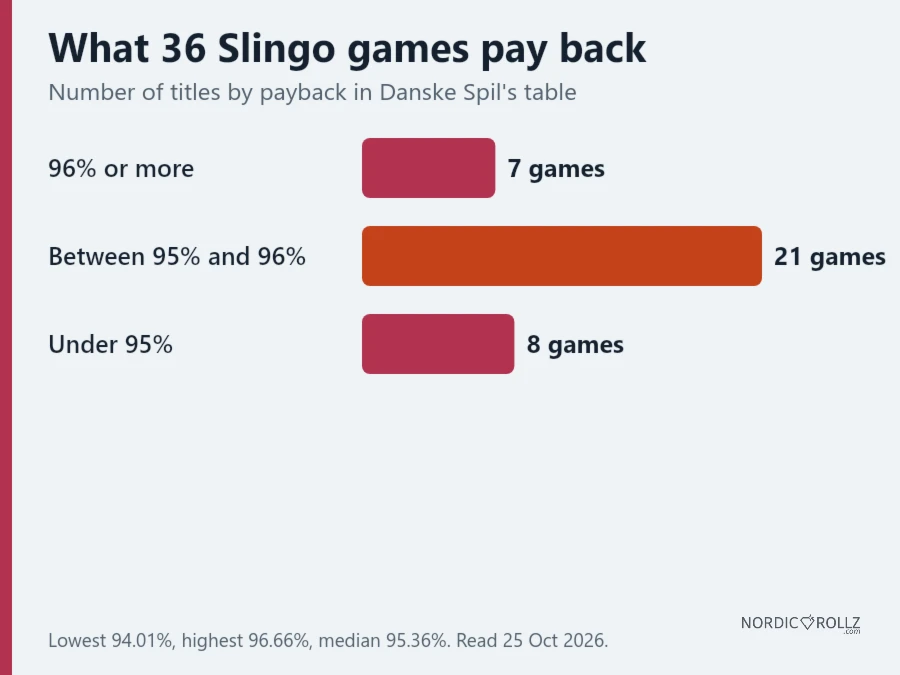
That is a narrow spread, about 2.65 points from bottom to top. It’s the same ballpark as a typical slot. If RTP is new to you, our RTP guide explains what the percentage means over a long run, and the house edge guide shows what the rest costs you. Danske Spil’s page doesn’t say whether its figure includes extra spins.
The maker does split them. Three rules pages print both figures:
| Title | Base game RTP | Each extra spin RTP |
|---|---|---|
| Lucky Joker | 94.27% | 94.00% |
| Hot Roll Slingo | 94.58% | at least 94.56% |
| Book of Slingo | 96.5% | 95.00% |
The gap is 0.27 points for Lucky Joker and 1.50 for Book of Slingo, and at most 0.02 for Hot Roll. Hot Roll says “minimum theoretical RTP”, so individual spins can be higher. All these figures are based on the best strategy the rules describe, which assumes you place every Wild perfectly.
The same title can differ by market too. Book of Slingo is 96.37% at Danske Spil and 96.5% in the Loto-Quebec rules. Tetris Slingo is 94.07% at Danske Spil and on Gaming Realms’ own game page. So check the RTP shown by the casino you actually use. Buying a feature changes the maths in other games too, as our bonus buy guide shows.
Both labels are in use. Gaming Realms lists Tetris Slingo as a “Video Slot”, and Danske Spil prints its Slingo figures inside the Bingo block of its winning chances table. Same product, two shelves.
We found no official classification from Spillemyndigheden or Spelinspektionen, so we don’t claim one. What we can say is what the maths looks like. Slingo pays back like a slot, in the mid-90s. The bingo rooms pay much less, as the section on Slingo in our bingo guide shows. And there’s no shared pot or other players, which is the part of bingo that makes it social.
In Denmark, the supplier side is licensed. AlchemyBet Limited, a Gaming Realms subsidiary, is on Spillemyndigheden’s list of licensed game suppliers. The supplier also holds a UK Gambling Commission account, number 30880, according to the Gaming Realms website.
We could confirm Slingo titles only at Danske Spil. We didn’t open the game catalogues of Veikkaus, Norsk Tipping, Svenska Spel or ATG, so we make no claim about them. Our casino list is the place to start if you want to compare casinos.
The game dates to the mid-1990s. Sal Falciglia is the named inventor on a US patent, US5647798A, for playing bingo on a slot machine, with a priority date of 10 March 1995. Gaming Realms bought the Slingo IP in 2015 for US$18 million, according to its own investor page. Gaming Realms owns the Slingo trademark today, according to the legal text on its rules pages.
The main decision inside the grid is where you place a Wild. The other choices are whether to buy extra spins, which bonus option to take and what limits to set. The rest is luck. So the tips are short.
Treat Slingo as paid entertainment, never as income. If a session stops being fun, stop.
We read the Gaming Realms rules pages, the Loto-Quebec rules PDF, Danske Spil’s winning chances table, Spillemyndigheden’s supplier list, the Gaming Realms investor page and the patent page on 25 October 2026. The odds and extra-spin chances come from our own simulation of a simplified grid, which shows why prices rise and isn’t any game’s real maths.
What we could not check matters too. We don’t know how a real game computes its extra-spin price. We found no official classification of Slingo by Spillemyndigheden or Spelinspektionen. We didn’t verify whether other Nordic operators offer Slingo.
We opened no account and did no hands-on test. How we work is in how we rate. For how volatility shapes a session, see our slot volatility guide.
It’s a single-player game that mixes a 5×5 bingo-style card with slot reels. You match the numbers that land to the card and complete lines to climb a prize ladder.
It depends on the title. The rules we read give Lucky Joker 8 spins, Hot Roll 10 and Book of Slingo 11.
A Wild lets you mark any number in the column above it. A Super Wild lets you mark any number in the grid.
The price depends on the grid position and the potential prizes. It’s shown on the spin button, and it can be higher than your base stake.
Danske Spil prints 94.01% to 96.66% for 36 titles. In the rules pages we read, the maker prints a separate, lower RTP for extra spins, for example 96.5% base and 95.00% per extra spin in Book of Slingo.
The maker calls Tetris Slingo a video slot, and Danske Spil lists Slingo with its bingo products. We found no official classification.
It’s extremely rare. In our simplified model with 5% wilds it came up once in 1,000,000 games, and never without wilds.
Yes. The rules describe Play Controls that cap the number and price of extra spins, the stake per game and the loss per game.


New reviews, guides and bonus news by email. Unsubscribe at any time.

NordicRollz is an independent casino comparison site covering the Nordic market: Norway, Sweden, Denmark, Finland, and Iceland. Published by NordicRollz LTD, Malta, we research and rate operators on licensing, payment methods, and player protections. Our reviews are not paid placements. For full details on how we evaluate casinos, see our How We Rate methodology and our Advertiser Disclosure.
Publisher: NordicRollz LTD
Company Number: 154921
Registered Address:
Tower Business Centre,
Tower Street, BKR 4013 Swatar, Malta
You are in safe hands


New reviews, guides and bonus news by email. Unsubscribe at any time.